



The question is not what you look at, but what you see. — Henry David Thoreau
This article is part of our CX–Contact Center Bridge Series — exploring the intersection of CX and Contact Centers, and the lessons, practices, and knowledge that flow both ways.
Shared Understanding
Great CX leaders know this well: two people can look at the same thing and see something entirely different.
That’s why they work to cultivate shared understanding — so teams interpret CX data, service interactions, and decisions in the same way.
- Sometimes it’s tradition: “We’ve always done it this way.”
- Sometimes it’s about beliefs: “Surveys are dead.” or “NPS is flawed.”
- And sometimes it’s about personal growth: “I never thought of it that way before.”
But often it’s simply a lack of shared understanding within a team.
What Is Leadership?
My favorite definition of leadership is simple: to inspire others to accomplish a shared goal.
But a shared goal requires a shared understanding.
If we all see the situation differently, we will act differently — and each of us will believe we’re right.
An Important Question
Seeing things differently is valuable. Some of you may have been saying this to yourselves already.
The real question is: when is it valuable to gather different perspectives, and when is it time to align on a shared understanding?
We Can Answer That Question Using Human Centered Design
Human Centered Design is an approach to problem-solving that focuses on understanding the needs and behaviors of people who will use the product or service that is being designed.
It involves continuous collaboration with the people we’re solving for throughout the design process – to ensure that the final solution meets their needs.
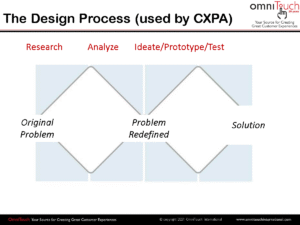 Here is the classic design process itself showing the design phases in red font.
With any Customer initiative – whether that’s a Customer-centric transformation or a refresh of Quality standards for the Contact Center – it’s valuable to have different people bring different points of view to the conversation.
I liken this to the Ideate phase in Human-Centered Design — a deliberate di
You can see the diamond opens. Bring on those ideas.
But at some point, only a few ideas will be considered worthy enough to take forward into prototyping and eventually the testing phases.
This is the converge phase. Decisions are made, options are narrowed, and a clear direction is chosen. The diamond in the picture closes.
We Get Behind the Ideas That Were Selected
Even if our own idea wasn’t one of those selected, we get behind those ideas that were selected to move forward in the process.
There’s a time to build consensus and consider different perspectives. And there’s a time to make decisions that we all get on board with.
Imagine ordering a vanilla latte at Starbucks, only to have the barista make it their own way instead of following the recipe. The result? Inconsistency — and disappointment.
As a Customer, you expect that there is a standard Starbucks recipe for a vanilla latte — and that it is followed.
And that the baristas who are serving your are on board with that recipe. Because if they aren’t, and prefer to do it their own way, you will notice.
Your CX Vision – A Powerful Tool for Cultivating Shared Understanding
At the macro level, crafting a meaningful CX Vision — and embedding it across the organization — is one of the most powerful ways CX leaders build shared understanding.
A meaningful CX Vision serves as both a guiding beacon and a shared lens — helping people across the organization interpret decisions and priorities in the same way.
But your shared understanding work doesn’t stop at the vision level.
It needs to be brought down to the places where people work. And the places where people might see things differently.
Opportunities to Cultivate Shared Understanding
Your Customer ecosystem is big – even huge.
Through the crafting and embedding of a meaningful CX Vision, you begin to improve alignment across the Customer ecosystem.
But there are many different departments and activities operating within your Customer ecosystem. So that means that you’ll have many opportunities to inspire shared understanding at functional levels as well.
One of the most popular and relevant functions for CX practitioners to explore is the Customer Service function.
As with any function, there are ‘things’ within the Customer Service function where the people who work there might see things differently.
Here are three examples from Customer Service:
1. Interpreting Interaction Quality
How would you describe the quality of that call recording that we just listened to? Was that a good call? A not so good call? What do you think?
In some Customer Service departments – when you listen to the Managers and Team Leaders talking about the quality of a call or email – their answers to these questions are all over the place.
One of the most foundational aspects of a strong Customer Service function is a shared understanding of what a good call sounds like — and why.
And something else to look out for – on a more strategic level.
Are the points that Customer Service management talks about in these quality conversations correlated in a meaningful way to the CX Vision?
Does the CX Vision serve as a lens through which to ‘see’ that call?
Of any two functions in the ecosystem where you’d expect to see close alignment it would be between the Customer Experience and the Customer Service functions.
2. Interpreting Metric Results
When you look at those 17 Contact Center metrics that you report every week – what do you ‘see’?
Recently a Contact Center Manager told me this:
Dan, our Reports people have lost the plot. They generate lots of reports but even they can’t quite explain why they do what they do.
Some Contact Center metrics are unnecessary, secondary at best, interpreted incorrectly, are weighted too much (or too little) or are interpreted in different ways among the Team.
A Contact Center is an “interrelated system of causes” — which is a fancy way of saying everything is connected. So it’s important to understand the interrelationships and trade-offs that exist between metrics.
And how to explain what they mean as they move together – not just how they move in isolation.
Looking at a dashboard of metrics, and having the entire Team accurately interpret what they ‘see’ – unlocks a world of shared understanding.
3. Interpreting How Customers Behave
When that Customer scolded you what did you ‘see’?
Some Frontline folks will tell you that they consider the Customer to be a ‘jerk’ after the Customer scolded them.
They might also express feeling ‘abused’ or believe that Customers should ‘know better’
We hear Frontline conversations like these all the time when we teach folks how to deal with difficult Customer situations. Even in deeply Customer-centric organizations, real world discussion about difficult Customers needs to happen.
Don’t assume that a shared understanding exists.
Because as you’ll find out when you start talking to Customer Service people, there can be a lack of distinction between Customer behavior that is indeed ‘abusive’ versus Customer behavior that we just don’t like.
These are not the same things — and confusing them leads to poor decisions and unnecessary conflict.
Helping your folks see that – and manage those situations better – is an important leadership responsibility.
Practitioner Questions Have Evolved
In our Management workshops – whether in CX or in Customer Service – we find that more Participants are asking questions like these –
- How can I get my bosses to see that our Contact Center is a profit center not a cost center?
- How can I get my Employees to see that the values we’ve chosen for culture change really matter?
- How can I get other departments to see how important CX is?
These are wonderful questions. Because they remind us – as Leaders at all levels – that we need to inspire people to accomplish a shared goal.
And to do that, we need to cultivate shared understanding — using our skill, knowledge, and experience.
Great CX leaders don’t just help people look — they help people see the same thing, and then act on it together.
Thank You for Reading
I regularly share stories, strategies, and insights from our work across Contact Centers, Customer Service, and Customer Experience. If this resonates, I’d love to stay connected.
You can drop me a line anytime, or subscribe on our site.
Daniel Ord
[email protected]
www.omnitouchinternational.com
