



“Customer Service isn’t Customer Experience.”
There’s a good follow-up question to that statement:
What parts of CX can Customer Service professionals actually use in their work?
In this article, I share four ways CX shows up in the day-to-day work of Customer Service professionals.
We see the world not as it is, but as we are. — Anaïs Nin
This article is part of our Customer Experience Hub — a collection of articles that explore the architecture, practices, and mindset behind great CX, all grounded in real-world teaching and consulting experience.
If you work in CX, you’ve seen those posts too.
The ones that remind everyone that Customer Service is not the same thing as Customer Experience.
Often punctuated with exclamation marks and a tone of frustration.
I’m not sure who these posts are meant for, but they don’t seem to be written for Customer Service professionals.
And that feels like a missed opportunity.
Time to Reach Across the Aisle
In my own training work across both CX and Customer Service, I’ve learned that the distinction is not as clear to Customer Service professionals as it is to CX professionals.
Which makes sense.
Customer Service has been around as a defined discipline for decades, practiced by people who have built entire careers around serving others.
So instead of dividing ourselves into camps, there’s a more useful question to ask:
What parts of Customer Experience can Customer Service professionals actually use in their work?
And how do we help them apply it?
By reaching across the aisle and sharing it with our Customer Service colleagues
After all, we can always use more Customer-focused people in the mix.
What I’ve Learned
For several years now, I’ve been teaching aspects of Customer Experience within our existing Team Leader and Frontline Service programs.
Recently, I brought those elements together into a dedicated Customer Experience course designed specifically for Team Leaders in Customer Service and Contact Centers.
Not to explain CX in theory.
But to answer a practical question:
What does CX actually look like in the day-to-day work of a Customer Service Team Leader?
CX Ideas Customer Service Teams Can Actually Use
In training Customer Service people across levels, a pattern has emerged.
There are many CX ideas that Customer Service professionals say they can apply directly in their work.
Here are four of those.
Think Beyond the Interaction
As you’d expect, Customer Service people tend to focus on the interaction — the call, the chat, the email.
Often, their understanding of the Customer journey begins and ends there — at the interaction itself.
The Customer contacts us, gets served, and the interaction is complete.
Customer Experience, by contrast, takes a broader view.
Journeys don’t just start and end in Customer Service — they cross multiple touchpoints and functions.
In training, I ask these questions:

Where in their journey did this Customer decide to contact us? What triggered them to reach out for help?
After they hang up, where will they go next? And more importantly, how can we help them have a smoother experience with what comes next?
Extending the lens beyond the interaction helps us take in the broader context — and consider how to be of even more service.
Understand What the Customer Will Do Next
The term strategic thinking gets thrown around a lot.
In the Customer Service context, strategic thinking means understanding how your work influences what Customers do next — and how that, in turn, impacts the business.
To explain this, I use a simple CX model:

Most Customer Service interactions focus on the first part — what actually happened.
When I observe coaching sessions, I’ll hear things like “you said this” or “you said that.”
But Customers don’t act on reality alone. They act based on how they perceive what happened.
And that perception drives what they do next — whether they complain, recommend you, or choose to do business with you again.
That’s the part that gets missed. It’s more than just whether you did what you were supposed to do.
It’s the link between the interaction, the Customer’s perception, and the business outcome.
Not All Moments Are Equal
CX people know that not all journeys are equal in the Customer’s mind. And that not all touchpoints within a journey carry the same weight.
Customer research helps us identify the journeys or moments that matter so we can allocate finite resources to where they’ll have the biggest impact.
Whether it’s time, money, or effort, it’s not our goal to make everything better.
Sometimes good is good enough.
In practice, this means making deliberate choices about what deserves our attention, what can wait, and what can even be left alone.
I think Customer Service people, at all levels, can benefit from understanding this type of thinking.
Not everything has equal weight — so focus on what matters most.
In a Contact Center we worked with, patience emerged as a key driver of overall Customer satisfaction with an interaction.
So the Center Manager there doubled down on refining and delivering patience across the team — and saw CSAT scores rise as a result.
The CX Pyramid
I’ll never forget a client who came to us for Mystery Shopper research, but specifically wanted a “Customer Experience” based program.
They knew that simply adding the term “CX” to a Mystery Shopper program didn’t make it so.
That’s when we introduced them to the CX Pyramid.
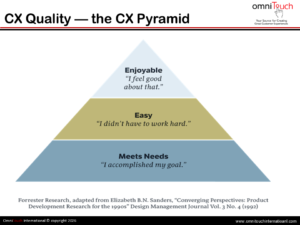
We conducted the research program across the three levels of Customer Experience quality.
How well were needs met?
How easy was it to get needs met?
How did the Customer (in our case, the Mystery Shopper) feel about what they went through?
We’ve also seen clients adopt the CX Pyramid as a listening lens for evaluating interactions.
It’s a bigger, broader, and more strategic way to consider how to improve service quality, beyond ticking boxes on a monitoring form.
People Are Selfish
People focus on what they’re responsible for, what they’re measured on, and what’s celebrated in the culture where they work.
In no way do I mean this to be harsh or judgmental.
It’s simply a reminder that rather than criticizing people for what they don’t know, the opportunity lies in helping them learn.
So they can do better in their own work and life.
And when we succeed at that, we earn a CX fan.
Isn’t that what it’s all about?
Additional Resources
If you’re looking to apply these ideas, here are a couple of useful resources:
Test your understanding of CX → 10 Quiz Questions on Customer Experience
A common mistake in Service Design → That Won’t Work for Our Customers
If you’re building these capabilities in your team, we cover them in our Customer Experience Management & CCXP Exam Preparation and Customer Experience for Team Leaders programs → Public Courses
Thank you for reading
I regularly share stories, strategies, and insights from our work across Contact Centers, Customer Service, and Customer Experience. If this article resonated with you, I’d be pleased to stay connected.
Feel free to get in touch anytime, or explore more of our work below.
Daniel Ord
[email protected]
