

We have a quality program. So why isn’t Quality improving? That’s what a CEO asked me and I share some ideas in this post.
This article introduces our Quality Management Series — practical guidance on designing, managing, and improving Quality in Customer Service and Contact Centers.
This article is also part of our Contact Center Management Series — a collection of articles that bring together practical guidance and insights to help Contact Centers run better and deliver stronger results.
By the nature of their role, CEOs are often removed from the day-to-day operations of the Contact Center.
Even those who champion service and spend regular time in the center ultimately rely on the center’s leadership team to manage the service function well.
So when a CEO takes me to the side of the room and asks, “Why isn’t our quality improving, even after all these years?” that tells you something important.
They see the quality activity, but not enough actual improvement.
Quality has come a long way since I started teaching it decades ago.
Participants in quality courses now speak confidently about calibration, monitoring forms, dashboards, and what AI can do for them.
But something still seems to get lost in the shuffle of all this quality activity.
It’s the human being — the customer service Advisor — who must ultimately turn all of this into great customer conversations.
Let’s go back to the CEO who asked, “Why isn’t our quality improving, even after all these years?”
Part of my answer was this: At times, quality activity is mistaken for capability building.
Of course, quality problems can also originate in poorly designed processes and systems.
But in this edition, I want to focus on the human side of the equation — where advisors become more capable in ways customers can actually feel.
Human Beings and Capability
Human beings are still at the center of the quality process.
And the good news is that a great deal is already known about what helps them develop capability.
We simply have to make the decision to use what is already known.
To help, here are three ideas.
Measurement Isn’t the Same as Improvement
Sometimes leadership assumes that handing someone a score is the same thing as helping them improve.
It isn’t.
 When I was in university my professors hosted office hours at scheduled times.
I could go into their offices, meet with them one-on-one, and get focused guidance on topics where I needed help — whether that was regression or conjugating French verbs.
Of course I never had to sit for an exam at the end of these office hours sessions.
The purpose of those sessions was to help me close my gaps as well as reinforce what I already knew.
When exam time did roll around, I tended to do well. Not because I am inherently smart — but because I got structured help.
The one-on-one help I got regularly from my professor helped me earn a better score on the exam.
But that understanding doesn’t always make it into the world of Customer Service quality.
I think it’s because it requires leadership — whether team leaders or quality assurance professionals — to provide regular help to advisors.
When I ask Contact Center leadership, “How many calls do you score a month per Advisor?” I always get a quick answer.
But when I ask, “How many calls do you assess in order to help your Advisor improve their capability?” I tend to get blank looks.
You mean you listen to a call without giving it a score?
That idea feels baffling to some.
There are two kinds of feedback*:
- Evaluative Feedback
- Improvement-Oriented Feedback
Evaluative Feedback involves a rating or score — your test result or the score on your last call.
Improvement-Oriented Feedback changes someone’s capability. There is no score. Just the devotion to helping someone get better.
When I share the example of my office hours with my professors, the best coaches immediately understand the point.
They already know how the two different types of feedback — Evaluative Feedback and Improvement-Oriented Feedback — work together to build capability in their people.
More Information Doesn’t Create More Learning
There is often a belief that the more information we give to our Advisor, the more they’ll be able to understand and apply.
AI and more dashboards have made it easier than ever to overwhelm people with information.
But that’s not how human beings work.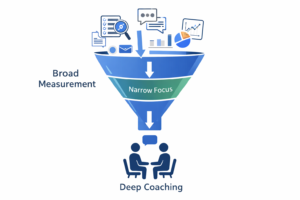
Learning doesn’t scale with the volume of information.
Rather than overwhelming an Advisor with everything they could have done differently, focus on the few things that will make the greatest difference.
Give them the opportunity to understand, practise, and apply those before moving on to something else.
Giving Feedback Isn’t the Achievement
Watch for the coach who thinks giving feedback is the achievement.
That’s a classic case of celebrating the activity versus looking at the outcome.
The first team leader says: “I do four calls per Advisor per month.”
The second team leader says:
“This month Alex raised his empathy performance by 30%, and Siti not only kept up her great courtesy, she also improved her tone of voice by 10%.”
I guarantee you that your CEO prefers the second example because it is focused on outcomes, not activity.
Coaching sessions should be capability building sessions, not counts.
Giving feedback is not the achievement.
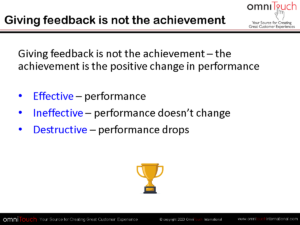
Sustained measurable improvement over time is the achievement.
If an Advisor isn’t improving — or their performance has actually declined — resist the temptation to point fingers at the Advisor.
Step back and look at the system in which that Advisor operates, along with the coaching and feedback they’re receiving, before jumping to conclusions.
*The approaches and terms for Evaluative Feedback and Improvement-Oriented Feedback originated in courses with Harvard Business School Professor Frances Frei.
Articles in the Quality Management Series
These articles explore Quality Management across standards, measurement, coaching, capability building, and Customer Experience.
Where Quality Assurance Programs Break Down
Why Quality Assurance programs can fail to improve frontline performance — and where to look when the problem lies in the Quality system itself.
Selecting Quality Standards for Better Customer Conversations
A practical approach to selecting Quality Standards that define what a great Customer conversation should look and sound like.
Why Your Call Quality Doesn’t Deliver on Customer Experience
Why traditional call Quality practices may not deliver the Customer Experience your organization intends.
From Compliance to Connection: Why Rules Alone Don’t Create Great CX
Why compliance matters, but rules and procedures alone are not enough to create better Customer conversations and experiences.
Your Super-High Quality Scores May Be Holding Your Team Back
Why consistently high Quality scores can conceal performance gaps and reduce opportunities for meaningful improvement.
When You Coach You’re Either Helping or Keeping Score
Why effective coaching should build capability rather than become another exercise in measurement and scoring.
“But My Way Is Better” — A Common Coaching Challenge
How coaches can avoid imposing their own preferences and keep coaching focused on agreed standards and better performance.
What a Great Quality Assurance Professional Can Do
What strong Quality Assurance professionals contribute beyond monitoring and scoring.
What Kind of Customer Experience Does Your Contact Center Deliver?
How the Quality of Customer conversations contributes to the wider Customer Experience delivered by your Contact Center.
Test Your Quality Assurance Knowledge
15 Quiz Questions on Quality Assurance (Part 1)
Test your understanding of Quality Assurance with 15 practical questions covering Customer Service and Contact Center Quality.
15 Quiz Questions on Quality Assurance (Part 2)
Continue testing your Quality Assurance knowledge with 15 more questions on Quality principles, practices, and decisions.
Thank You for Reading
I regularly share stories, strategies, and insights from our work across Contact Centers, Customer Service, and Customer Experience. If this article resonated with you, I’d be pleased to stay connected.
Feel free to get in touch anytime, or explore more of our work below.
Daniel Ord
[email protected]
www.omnitouchinternational.com