


In this article, I share how to prepare a professional Training Brief along with useful visualizations.
This article is part of our Craft of Training & Speaking Series — tools and techniques for anyone who teaches, facilitates, or speaks to move people to think and act.
The definition of the problem is already half the solution.— Charles Kettering
We receive a lot of enquiries for training
Some of these enquiries are very clear. They are well thought through and presented.
That makes it easy for us to make a clear and considered reply with a robust set of recommendations.
But sometimes we get one-line emails
“We need to train people in Customer Service – send us your outline & rates.”
Or –
“We need our people to be trained in 2-hour shifts on alternate Fridays — send us your proposal.”
These types of enquiries aren’t easy to work with. And often put tactics in front of strategy.
That’s why we created this simple training brief process and convenient handout.
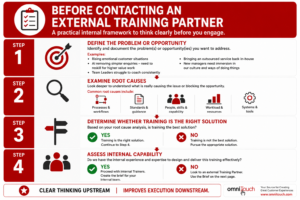
The Internal Steps Diagram
The first four steps in the process are largely internal to you and your organization.
The decision about whether or not to bring in an external training partner is made in Step 4.
To help follow the process, we created this visualization which covers Steps 1-4.
A broader explanation of each step, along with relevant examples, comes after the visualization.
Step One: Document the Problem or Opportunity
We always recommend that you first identify and document the problem or opportunity you’d like to address.
Two to three sentences per problem or opportunity is enough.
Examples:
AI has taken over a large percentage of the simpler customer enquiries, so we’d like to reskill our people to provide consultative advice to customers as a paid model.
We’ve identified that the rate of difficult emotional customer situations has increased, so we’d like to equip our people to manage these complex and emotional situations better.
Selling is becoming an integral part of our service solutions, so we’d like to help our frontline incorporate upselling and cross-selling into relevant customer conversations.
Our team leaders have good intentions but we notice they struggle to improve performance across members of their team.
We are bringing outsourced service operations back in-house, so we want to immerse the new managers joining us in our culture and ways of doing things.
Of course, further discussion will help unpack the situation in more detail.
But these statements provide an understanding of the desired shift from the current state to a desired future state.
Step Two: Examine Root Causes
When problems or opportunities crop up in the workplace, it’s often easy to assume that training is the solution.
But training is never the solution to everything.
Once you’re done with Step One, continue by examining the root causes of the current problem or the potential barriers to the identified opportunity.
For example:
If customers are frustrated because policies are unclear, training alone may not solve the issue.
If team leaders are not coaching effectively because they manage 25 people each, the issue may be workload and structure rather than capability.
If written communication quality is inconsistent, sometimes the existing corporate standards guide is too vague to apply and needs clearer expectations and examples.
Step Three: Determine if Training is the Right Solution
Having completed Step Two, you should be able to determine whether training is the right solution.
Or change the scope of training that might be needed.
Step Four: Assess Internal Capability
When you determine that training is the right solution — the next step is to decide if your internal team has the experience and expertise necessary to design and conduct the training.
If so — give the brief to your internal people and let them do the work.
Otherwise — contact an external training partner with the requisite know-how and experience.
If we’ve decided to contact an external training provider, the process carries on to the external steps.
The External Steps Diagram
The next six steps involve communicating directly with an external training partner.
To help follow the process, we created this additional visualization which covers Steps 1-6.
A broader explanation of each step, along with relevant examples, comes after the visualization.

Step One: Describe the Job Role(s) or Functions You Plan to Train
Be as clear as you can about who will participate in the training.
For example:
- Non-Customer facing job roles
- Contact Centre agents
- Customer Experience professionals
- An entire department across levels
- The organization at large
An understanding of the job role is always helpful.
Step Two: Estimate the Number of Participants by Job Role or Function
There are different facilitation approaches when working with a group of five people versus a group of 500.
When you can, provide estimates for the number of participants and a short description of their job titles or roles.
Example:
The audience for your talk will consist of senior management across all functions in the organization including finance, legal, IT (and so on). We estimate between 25 – 30 participants in total.
Step Three: Share the Problem(s) and/or Opportunities
What is the problem to be solved? What are the opportunities to be unleashed?
You can pick this up from the internal work you did earlier (Step One, internal) and provide it to the training partner.
If the problem or opportunity has been reiterated as part of the earlier discussions, be sure to give the training partner the latest version.
Step Four: Share Ancillary or Contextual Information
What’s going on inside your organization?
Are you new in the market or region? Is there a consolidation or reorganization? Are there new initiatives? Has morale fallen? Has a new CEO come in? Is there a transformation underway?
The more your training partner understands the situation, the better their recommendations are likely to be.
We had the example of teaching CX to a group of senior managers in the pharmaceuticals industry, and we were told in advance that though these participants had very high academic qualifications, CX was a new business discipline for them.
Step Five: List Your Objectives for Training
It’s always worth jotting down a few key objectives for the training.
I find that the quality of objectives works better than the quantity of objectives in this phase. There will be plenty of time later on to dig into more granular aspects of the training content.
I suggest you use phrasing such as –
As a result of this training, participants should be able to: _________.
And then use verbs such as:
- Design an effective quality program
- Know how to deliver feedback well
- Use a 9-step email writing process
You don’t have to spell out every single objective. Simply by laying out the top 3 you provide your training partner with direction.
Step Six: Tactical Details
Special requests about dates, days of the week, online versus offline, venue, catering and the like are common tactical details in training.
It’s best not to start your thinking with these details — generally these can be sorted out once the strategic objectives for training have been addressed.
We’ve often seen that after strategic considerations have been addressed, the tactical details may change anyway.
For example, we’ve had clients say:
“We’re so happy with the proposed outline, we’ve decided to include more people in the program.”
“Our senior people have expressed interest in having a private run prior to the official launch.”
“We have offices in 4 continents and realize that we can bring everyone together across 2-4 hours time windows online.”
“We’d like to fly you in to present this at our corporate headquarters.”
Of course all training details matter.
The point is simply to keep these as secondary considerations rather than primary ones.
The Benefits of a Training Brief
The benefits of organizing a professional training brief are significant for your organization:
- Helps internal stakeholders align around the real problem or opportunity
- Encourages strategic thinking before tactical decisions are made
- Improves the ability to assess and compare external training partners
Your external training partner benefits as well:
- Helps them provide better recommendations more quickly
- Gives them the context necessary to ask stronger follow-up questions
- Improves the quality and relevance of proposed outlines and solutions
This isn’t meant to be a rigid process or formal document. Use the parts that help your organization think more clearly.
The strongest training partnerships usually begin with clarity
Enough clarity for both sides to understand the desired shift from the current state to a better future state.
This kind of thoughtful work upstream improves execution downstream. Which is good for everyone, especially those in the training room.
Additional Resources
What Training Engagement Really Means — And How To Earn It
Learn about → The Team Leader Training Series for Contact Center & Service Teams
View our Public Course Calendar
Thank You for Reading
I regularly share stories, strategies, and insights from our work across Contact Centers, Customer Service, and Customer Experience. If this resonates, I’d love to stay connected.
You can drop me a line anytime, or subscribe via our website.
Daniel Ord
[email protected]
www.omnitouchinternational.com
