

Customer Experience is both a strategy and a discipline — and it often comes alive in those surprise moments in CX training when something suddenly clicks.
This article is part of our Customer Experience Hub — a collection of articles that explore the architecture, practices, and mindset behind great CX, all grounded in real-world teaching and consulting experience.
Oh! Moments
In 10+ years of delivering CX Management Training, I’ve noticed moments that spark real surprise and discussion with participants.
I call these Oh! Moments.
These are surprise moments in CX training where Participants say: “Oh… that completely changes how I understand this.”
Our Guest Contributor
In this article, I’m joined by our Guest Contributor Dirk Sperrfechter, Senior Director Global Business Development @Kantar.
Surprise is a signal. It tells us where our frameworks need updating — where our mental models are out of sync with reality. — Dirk Sperrfechter
Dirk says: WHY THESE OH! MOMENTS MATTER
Reading through Daniel’s reflections, I’m struck by how often the Oh! Moments in CX come not from complexity — but from clarity.
These aren’t revelations buried in obscure theory.
They’re truths hiding in plain sight.
And yet even the most experienced professionals can miss them.
Why?
Because CX isn’t just a discipline — it’s a mindset.
And like any mindset, it’s shaped by habits, assumptions, and the pressures of daily operations.
What Daniel surfaces in his teaching are the blind spots that even smart, committed people develop when they’re deep in the trenches.
Our Three Oh! Moments for this Article
For this article I’ve chosen three topics from our CX course that always generate surprise and discussion:

- The Mini-MBA: Essential Know-How to develop CX Strategy
- Understanding Fundamental CX Architecture
- The Power & Process of the CX Vision
My intention is to highlight each topic, provide context around what we talk about, and share why I think each topic resonates so much with Participants.
And of course Dirk is here to share his thoughts too.
Oh! Moment #1: The Mini-MBA for CX Strategy
In our course, when it’s time to talk about CX Strategy, I begin with our Mini-MBA — a practical foundation in organizational strategy, objectives and related business terms.
I tell Participants:
“If you’ve got an MBA, this may be a refresher — but hang in there, because we’ll connect it directly to CX. If you don’t have an MBA that’s ok too – that’s exactly why we’re covering this material now.”
There are a couple of important truths that apply in our Mini-MBA:
- You can’t build a credible CX Strategy without understanding the Organization’s strategy first.
- If your senior leaders can’t see and feel the company’s DNA in your CX efforts, you’ve got a big problem and you’ll quickly lose traction — and credibility.
So we start our Mini-MBA with the fundamentals — three elements that together, tell the organization’s story: 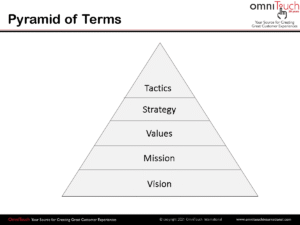
- The Vision — where the organization wants to go
- The Mission — what it does every day
- The Values — what guides decisions and behaviors
Then, in an exercise people really enjoy, we take out our phones and look up the Vision, Mission and Values of different organizations of our choice.
As Participants share what they read, they can see for themselves how all over the place these statements can be. Ranging from superbly written to vague and incomprehensible.
The Role of Strategy & Strategic Objectives
After covering Vision, Mission & Values, we shift our attention to different strategy types – such as cost leadership, focus and differentiation — along with specific company examples for each.
And we compare companies operating in the same industry – but which pursue significantly different business strategies and strategic objectives.
Simply to highlight that every organization is unique. So to set the foundation for your CX work, it’s important to deep dive into what makes your organization tick.
Organizational strategy shapes the choice of key strategic objectives — the big goals an organization sets to guide and test the effectiveness of its strategy.
Every CX professional should know the key strategic objectives that matter most where they work — by heart — and work to see how CX can contribute to achieving those objectives.
Why I Think the Mini-MBA Works Well
When I wrote this content I didn’t expect it to resonate as much as it does. But in nearly every session, Participants tell us that this was one of their favorite parts of the course.
Not all CX and Customer Service professionals come from a business, finance or strategy background — so this content, and the clarity it brings, is genuinely new.
And it helps make the connection between Organizational Strategy and CX Strategy understandable and real.

Before the course, many Participants believed CX was primarily about “delighting” Customers and reducing friction – what I sometimes refer to as “Customer Service on steroids.”
But in our section on strategy, I ask people to consider these questions:
- “Can you articulate your organization’s strategy?”
- “Can you name the top three strategic objectives that matter at your organization?”
Many Participants pause here — and then admit they’re not sure.
They’ve never had to answer those questions before.
Even in organizations where they may have worked for years.
But nearly all of them say: “I’m going to go back and learn this.” They realize:
You can’t create a meaningful CX Strategy if you don’t understand the organizational strategy it’s meant to support.
What to Remember for This Oh! Moment
Don’t assume that business concepts and terms like Vision, Organizational Strategy or Strategic Objectives are deeply understood — I’ve found that’s not always true.
Start by understanding your Organization’s strategy — it’s critical to designing the eventual CX Strategy.
To gain executive sponsorship, your CX Strategy should be anchored in the broader organizational strategy.
Oh! Moment #2: Understanding CX Architecture
At the beginning of the course, we read and discuss different definitions of Customer Experience written by leading thinkers in the industry.
We look for the commonalities and the differences.
 Everyone decides, individually, how they would answer the question, “What is Customer Experience?”
Because at some point, they will be asked — and it’s important to have a meaningful answer.
Next, we take the term ‘Customer Experience’ and add the word Management to it. Thus transforming ‘Customer Experience’ into ‘Customer Experience Management’.
- Because Customer Experience as a term just describes something.
- While Customer Experience Management implies the doing (or managing) of something.
So we get our definitions of CX and CX Management taken care of early on.
And periodically re-visit and re-evaluate those definitions as we progress through the course.
For me it’s important to define CX and CX Management – before we shift into the discussion on CX Architecture.
Understanding CX Architecture
There’s a core architecture behind Customer Experience that helps us study what Customers go through — and at what level.
So we walk through that CX Architecture step by step — from the broadest time horizon down to the most specific micro-touch.
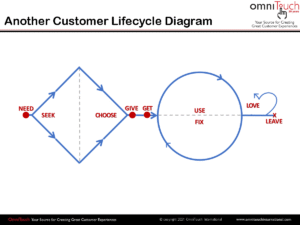
Like descending rungs on a ladder, we introduce and define:
- The Customer Lifecycle — the broadest time horizon, covering the full relationship from beginning to end
- Stages within the Lifecycle — segments that organize the lifecycle into logical phases
- Customer Journeys — the steps Customers take to achieve a specific goal
- Touchpoints — the individual touches and interactions Customers encounter along their journeys with us
These terms are usually familiar to people — but not always deeply understood or recognized as integrated elements in an overall framework.
Take the Customer Lifecycle and the Customer Journey
The Customer Lifecycle and the Customer Journey aren’t the same thing — and the terms are not interchangeable.
But people mix them up:
- The Customer Lifecycle is the entire span of a Customer’s relationship with an organization — from beginning to end.
Example: I may buy a car from Brand A and keep it for 10 years. That’s a 10-year lifecycle. When I switch to Brand B, the Lifecycle with Brand A ends. - A Customer Journey focuses on achieving a specific goal within that relationship.
Example: I need to get my car serviced. That’s a Journey — and it may include multiple Touchpoints like booking the appointment, arriving at the dealership and picking up the car when they’re done.
Even within Customer Journeys, there can be a deeper and more layered architecture.
Applying to university might be a broader or higher level macro-Journey.
Writing your personal essay as part of applying to a university is a narrower micro-journey – with its own focused goal and specific steps to achieve it.
People Working in Contact Centers Have Another Oh! Moment of Their Own
For Participants from Customer Service and Contact Centers, another Oh! Moment regularly pops up.
In the Contact Center world, it’s common to be told (over and over) that your Touchpoint — the call, the chat, the Service Counter — is the most important Touchpoint of all.
And sure — sometimes it is. But it’s never the only Touchpoint in a Customer Journey.
And CX professionals often design Customer Journeys that don’t require Customer Service at all.
The realization — that in the Contact Center, we’re a Touchpoint within a specific Customer Journey — can reframe how Service professionals view their impact.
Not necessarily as the center of the experience but a vital part of something bigger. Which can be empowering — and improve cross-functional relationships.
Why I Think the Understanding CX Architecture Works Well
Participants regularly say things like:
“I always thought a Journey was the same as the Lifecycle. No one ever explained the difference.”
“So my Customer Lifecycle could be five years long — but a Journey might just be getting a product repaired.”
“My boss told me something completely different…so I have to go back and explain this to them.” (this case happens more than you’d think)
When everyone shares the same understanding of how the architecture works and how to use it, it’s easier to:
- Align how experiences are described, studied and understood
- Ensure that all aspects of the experience — from broad Lifecycle Stages down to Touchpoints — are considered
- Understand where your ‘Voice of Customer’ listening posts will be
What to Remember for This Oh! Moment
CX Architecture provides structure for understanding and improving Customer experience(s).
The Customer Lifecycle (the full relationship) is not the same as a Customer Journey (a goal-based episode).
Journeys contain multiple Touchpoints — and not all involve Customer Service.
On to our third Oh! Moment
The first two Oh! Moments — the Mini-MBA and CX Architecture — focus on business alignment and structure.
But this third moment consistently sparks something different. It’s less about structure — and more about the story.
It’s about the power of crafting a clear and robust CX Vision to align people, guide decisions and enable behavioral change.
Oh! Moment #3: The CX Vision
In the course, I share a strategic framework from USAA — a financial services firm that frequently ranks among the best in the world for its CX.
I’m even a USAA Customer – so I know how great they are to work with.
USAA’s VP of Enterprise Strategy outlined four parts of a sound business strategy:
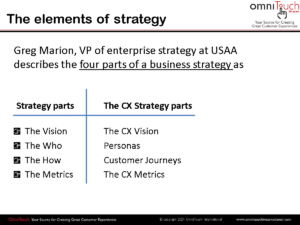
- The Vision
- The Who – (Who we serve)
- The How – (How we serve them)
- The Metrics – (to guide and track progress)
You can see his strategy parts in the left hand column from top to bottom.
What I did was add to his framework with the corresponding CX Strategy parts – what you see in the right hand column:
- The CX Vision
- The Who – Personas
- The How – Customer Journeys
- The CX Metrics
I let Participants know that — though we’ll explore all four parts in the course — we start with the CX Vision for a reason.
The CX Vision describes the specific experience you want every Customer to have — consistently and intentionally. It’s a unifying force — and it requires a deep dive into the Customer’s world.
Let’s Order Ice Cream
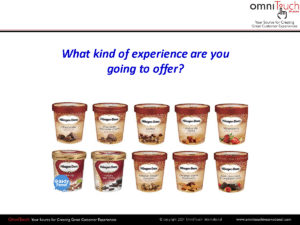 You don’t walk into an ice cream shop, look at the 50 different flavors laid out before you and say –
“I’d like some ice cream please.”
The person behind the counter wouldn’t know what you want.
Instead, you say –
“I’d like the vanilla strawberry ripple, please.” Or
“I’d like the fudge brownie with chocolate chips, please.”
You’d be specific — almost ridiculously specific — to get what you want.
Your CX Vision works the same way — it shouldn’t be about abstract ideals or vague happy language.
It’s about being concrete and easy to operationalize, so that the Employees in your organization can understand it and use it well.
This ice cream analogy always works. I think in part because Participants can see why a vague CX Vision fails.
The Process to Create a CX Vision
Now we transition from discussion of what a specific and clear CX Vision is — to the process of how to create one.
For me, creating a robust CX Vision is like making a smoothie.
When you’re making a smoothie, you gather together a variety of ingredients – bananas, yoghurt and honey for example – put them all into a blender and mix them up.
Well, the art and science of creating your CX Vision is similar. You gather together different and important inputs and blend them together to create your CX Vision.
When I teach this process, I recommend starting with the key inputs that reflect who you are as an organization — things like your:
- Vision
- Mission
- Values
- Strategy
- Strategic Objectives
- Brand Promises
- And the like
The clues to who you are are usually hidden in plain sight. Even studying your own website can be valuable.
And when it comes to strategy and strategic objectives, I suggest that CX people go talk to people like the CFO, COO and CEO.
Learn what matters to these people in your organization — and why it matters — so that you can be of practical help.
What Inputs Do You Need?
It’s easy to say go find out your Customer expectations — but there’s serious work to be done here.
To gather what Customers expect requires research — a mix of quantitative and qualitative insight.
Though in the course we’ve not yet covered the Customer Research content, I always emphasize the value of qualitative research. It’s never just about the scores on a survey.
One global CX Leader of the Year award winner shared in his story that he spent six months just reading Customer comments, talking to Customers and talking to Employees about Customers.
All to figure out what Customers at his organization expected. And from which he artfully blended everything together to craft a meaningful and practical CX Vision.
Dirk says:
“CX is deceptively human. Metrics, ROI, and VOC programs are essential — but they’re scaffolding. The real structure is built on empathy, perception, and expectation.
That’s why something as ‘soft’ as understanding expectations can be so powerful — and so often overlooked.”
Why the CX Vision Works Well
When people hear the word Vision, it’s easy to zone out. The term itself sounds lofty and abstract.
And quite a few Participants tell me that — before taking the course — they had been using their Organizational Vision or Mission Statement and even their Community Standards (a government agency here) as their official CX Vision.
Fortunately, after we work through the topic, Participants see how important it is to get the CX Vision right — and not just lift lofty sounding words from elsewhere.
And I think the process itself — diving into both the Organization and the Customer’s world — makes the work so enriching and insightful.
Participants write to us months after the course and tell us:
Until I did this work myself, I didn’t realize how much we needed to clarify internally, about our business. Or how much we had assumed about what our Customers really expect.
What to Remember for This Oh! Moment
The CX Vision is an integral part of your overall CX Strategy
Your CX Vision should be specific, clear and actionable — not vague
The CX Vision should not be confused with the Organization’s Vision, Purpose or Values — it serves a distinct and practical purpose
It draws from both internal inputs (strategy, values, objectives, brand promises) and external insights (Customer needs, wants and expectations)
Qualitative research is vital for surfacing what Customers expect
- A strong CX Vision aligns teams, guides decisions and inspires meaningful behavioral change — which is at the heart of transformation
Recap of the Three Oh! Moments
Here is quick recap of the three Oh! Moments that we’ve covered in this article:
| Oh! Moment | Key Insight | Action Step |
| Mini-MBA | CX Strategy must align with Organizational strategy | Review your Mini-MBA concepts: Including Vision, Mission, Strategy, Strategic Objectives and more |
| CX Architecture | Lifecycle ≠ Journey ≠ Touchpoint | Clarify and standardize the CX Architecture framework that you will use and share the framework |
| CX Vision | Clarity drives alignment and enables transformation | Blend ‘who we are’ as an organization with ‘what our Customers expect from us’ to craft your purpose-built CX Vision |
Dirk Says
We need to unlearn to learn.
Many of the surprises Daniel shares are about letting go — of outdated KPIs, of assumptions about Customer behaviour, of the idea that more data always means better insight.
That unlearning is hard, but it’s where real growth happens.
The role of a CX leader is to challenge comfort zones — not just for Customers, but for Teams, Stakeholders and even ourselves. If we’re not occasionally surprised, we’re probably not pushing far enough.
So when Daniel says, “This surprised them,” I hear, “This changed them.”
And that’s the kind of learning that sticks.
Thank You for Reading
Dirk and I truly appreciate the time you’ve taken to explore these CX “Oh!” Moments with us. We look forward to sharing more of these insights from CX Management training in future articles.
I regularly share stories, strategies, and insights from our work across Contact Centers, Customer Service, and Customer Experience. If this resonates, I’d love to stay connected.
You can drop me a line anytime, or subscribe via our website.
Daniel Ord
[email protected]
www.omnitouchinternational.com