
A simple question asked on two continents revealed a customer service lesson about professionalism, service, and being human.
This article is part of our Customer Service Series — reflections and lessons on how service is designed, delivered, and experienced, from Frontline conversations to leadership choices.
Look for the similarities first, not the differences.
A week before speaking at a Customer Service conference in Athens, I was facilitating a private training class in Australia.
During the session in Australia, I asked participants a simple question:
“What customer behaviors irritate you?”
The responses came quickly.
- They repeat themselves.
- They won’t listen to me.
- They threaten to complain on social media.
- They use capital letters and exclamation points.
- They talk down to me.
The list went on and on.
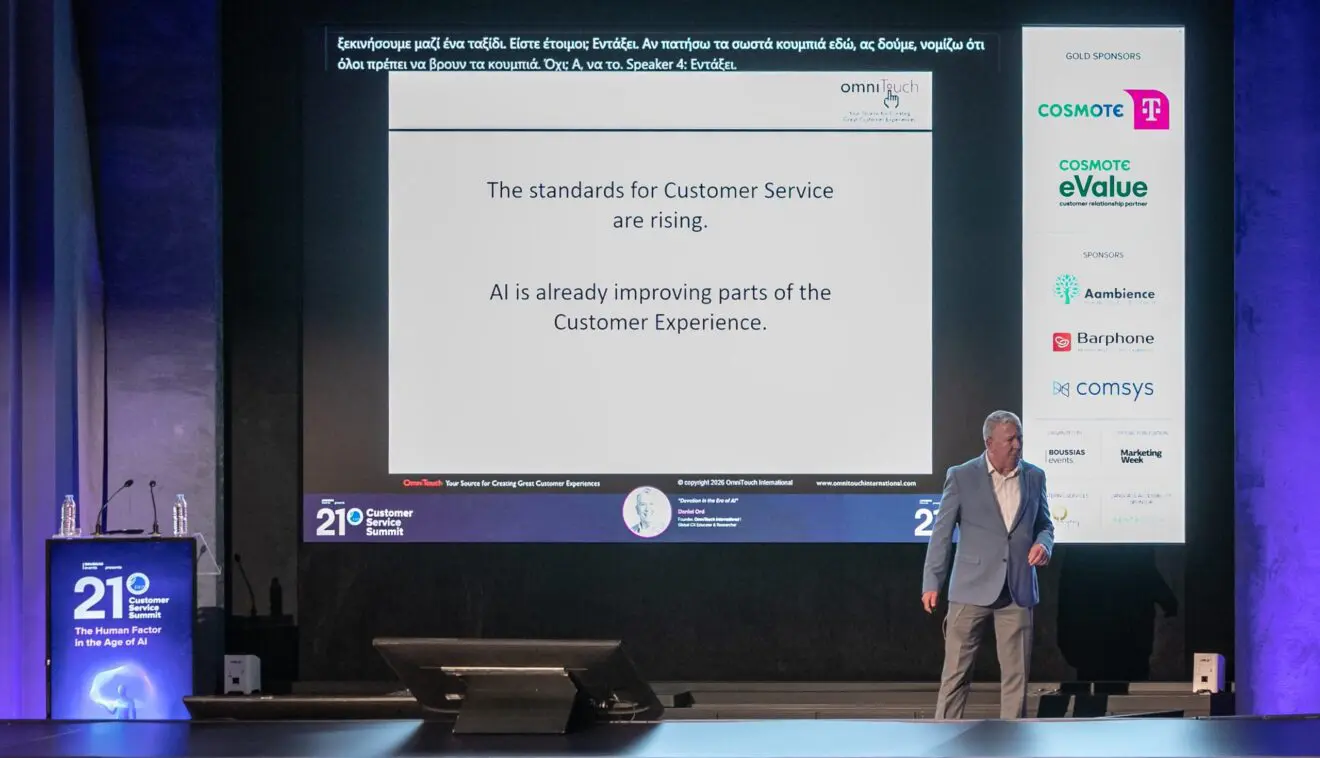
A week later, standing on a stage in Greece, I asked the same question.
The responses, entered by audience members using their phones, appeared live on the conference screen.
And the answers were almost exactly the same.
After teaching in more than 75 countries, this outcome didn’t surprise me.
- Customers around the world exhibit many of the same behaviors that employees find irritating.
- Employees around the world report many of the same frustrations when serving customers.
- Leaders around the world face the same challenge: helping their teams deliver consistent service despite those frustrations.
And whether I ask this question in Brussels, Manila, or Sydney, the answers are almost always the same.
The important point isn’t that we occasionally feel irritated by someone else’s behavior.
After 25 years of teaching service, I’ve yet to meet a frontline employee who never feels frustrated or annoyed.
We can’t talk endlessly about being human without talking about these kinds of feelings.
After discussing irritating customer behaviors, I ask participants to answer the question below:
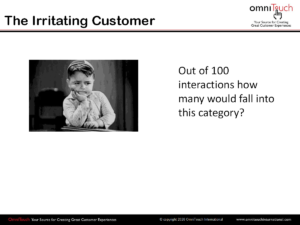
I first included this question in a Customer Service course I developed in 1999.
So I’ve been asking it for a long time.
And in both Australia and Greece the answers came in largely as expected.
Roughly 20%-30% of customers exhibit behaviors that employees find irritating.
I don’t claim that’s an industry standard. But I can tell you there is a pattern to both the answers themselves and the rate experienced.
No matter where in the world I’m working.
I think feeling irritated at times is human.
The important point is what happens next.
Professionalism means not allowing those feelings of irritation to determine the quality of service we provide.
Which is why, when the conference organizer in Athens asked what music I wanted played as I walked on stage, I chose the classic disco song I Will Survive by Gloria Gaynor.
Because dealing with people who exhibit behaviors that irritate you isn’t just a service skill.
Whether you live in Australia or Greece.
Thank You for Reading
I regularly share stories, strategies, and insights from our work across Contact Centers, Customer Service, and Customer Experience. If this article resonated with you, I’d be pleased to stay connected.
Feel free to get in touch anytime, or explore more of our work below.
Daniel Ord
[email protected] / www.omnitouchinternational.com