

This article explores what it takes to move from Contact Center Management to Customer Experience leadership.
This article is part of our CX–Contact Center Bridge Series — exploring the intersection of CX and Contact Centers, and the knowledge, practices, and lessons that flow both ways.
It is also included in our Contact Center Management Series and our Customer Experience Hub.
It Seems to Be a Logical Move
One of the questions I’m asked by Contact Center Managers in training courses is what it takes to move into Customer Experience leadership.
The first thing to understand is that Customer Experience Management is a different discipline from Contact Center Management.
There are points of overlap, but as disciplines they are not interchangeable.
Nor is Customer Experience Management in any way better than Contact Center Management.
Before assuming the grass is greener on the CX Management side of the fence, it’s important to understand how your experience has been built and where your strengths lie.
Those are useful starting points for considering whether you’re ready to make the move.
How Serious is Your Current Organization about CX?
Not every organization genuinely pursues Customer Experience as a business strategy.
That’s an important starting point.
Of course, no smart CEO is going to publicly disparage Customer Experience. They may even refer to an NPS score now and again.
But talking about Customer Experience and building the organizational practices to deliver it are two very different things.
Organizations that are serious about CX use maturity models to assess their current-state customer-centric practices.
I’ve always liked the maturity model approach because there is rigor in it. CX is more than a vibe.
Regardless of which CX maturity framework you use, the question is universal: where are we now across the necessary practices and how committed are we to improving where we need to?
Given that it can take time to move up the CX maturity scale, there needs to be a firm commitment from leadership.
You’re not going to move up the maturity scale in one quarter.
If you want to move into Customer Experience leadership where you work now, you’ll want to know where your organization truly sits today — and how committed it is to maturing the necessary practices.
If you’re considering moving to another organization, this is a question you’ll still want to answer before you commit to a new CX role.
Customer Experience Isn’t Customer Service on Steroids
One of the most common misconceptions I encounter with Contact Center participants who join our CX training course is their belief that Customer Experience is a form of Customer Service on steroids.
Some expect the CX course to teach them how to deliver a better phone call or increase the motivation of their team members.
Only to quickly find out that’s not at all the topic at hand.
Customer Service is a subset of Customer Experience.
And the Contact Center is a subset of Customer Service.
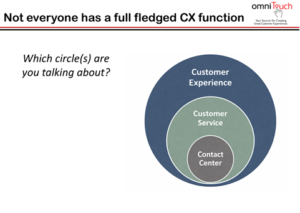
When someone starts talking about calls and live chats, I know they’re talking within the Contact Center circle.
If they talk about a service delivery vision, I know they’re talking within the Customer Service circle.
CX folks, in contrast, tend to talk about the organization at large.
Of course they’ll dive into how they helped a department improve its performance, but their playing field is the entire organizational ecosystem.
Most Customer journeys are going to touch many different functions.
The Contact Center is one touchpoint in the larger ecosystem — and one that not every Customer will actually use.
If you mix up Customer Service and Customer Experience, you won’t just confuse yourself.
You’ll confuse everybody around you as well.
What Your Contact Center Operation Reveals
Let’s look at how you manage your Contact Center today.
The way a Center is managed often reveals far more than how efficiently it operates.
It reflects the priorities of the wider organization, the behaviours that are rewarded, and the way people in the Center think about Customers.
These same factors play out on an organizational scale in a Customer Experience role.
Your Contact Center isn’t a test of whether you’ll succeed in CX leadership. But how you manage it can offer some useful clues about how you think about Customer Experience.
Let’s look at a few examples.
How You Pursue Efficiency Matters
Efficiency matters in a Contact Center — but how you pursue efficiency tells us something about how you think about Customer Experience.
If your primary focus is on metrics such as Number of Calls Handled or Average Handling Time, you are working to optimize efficiency — not the Customer Experience.
Or put another way, there’s a benefit to the organization (reduced costs) while there may be a negative impact on Customers (reduced quality, feeling rushed).
It’s worth stepping back and asking: Do the metrics I prioritize in my Center consider the Customer’s point of view? Or do they skew towards cost efficiency?
Decisions made with a Customer Experience lens should be good for the Customer and good for the Organization.
Not necessarily within the same time period, but the benefits to both should be evident over time.

How You Pursue Quality Matters
Quality matters.
But improving quality matters more than how many different ways you measure it.
Is quality improvement driven through ongoing coaching and dialogue?
Or does your Center operate like a scorecard factory, where measurement substitutes for coaching conversations?
The true purpose of a Quality Assurance function — and the people who work in it — is to help frontline professionals measurably develop their skills so that Customers have better experiences.
Customer Experience is ultimately about people — not a scorecard.
Your ability to help people improve is a good sign if you choose to move into Customer Experience leadership.
What Kind of Culture Have You Built in Your Center?
When your Frontline Advisors talk about Customers, how do they describe them?
Do they describe them as irritating? Entitled? Annoying? Unreasonable?
Do your Team Leaders chime in and say the same thing?
If so, you’ve got a culture issue within your Contact Center.
If there’s any place where a customer-centric culture should be strongest, it’s the Contact Center.
If you’ve successfully built a customer-centric culture within your Contact Center, that bodes well for your ability to help build one across a wider organization.
Customer Experience Is a Business Discipline
Customer Experience is sometimes dismissed as “fluffy” — in part because its advocates fail to articulate its value in business terms.
Many Contact Center Managers already have experience with budgeting, ROI analysis, and making sound trade-off decisions.
These business skills are not optional in Customer Experience leadership — they are foundational.
Arguing for a Customer Experience initiative because it “feels right” may actually limit your influence with leaders in other functions.
Effective Customer Experience leaders inspire — but they also build business cases and demonstrate value in commercial terms.
The Power of Influence
The most effective Contact Center leaders work up and out.
They build strong leadership beneath them so they can work across functions — IT, Marketing, Sales, Finance, Product, and others — to solve Customer problems collectively.
CX leadership is political in the sense that influence, reputation, and trust have a significant impact on what gets done.
Your Contact Center Experience Is an Advantage
I don’t believe it’s necessary to come up through the Contact Center industry to become an effective Customer Experience leader.
But Contact Center Managers often have a distinct advantage.
They understand Customers, operational complexity, people leadership, and the business realities of delivering service every day.
If you’ve built a customer-centric culture, learned to think commercially, and are able to influence across functions, you’re already well on your way.
And whatever you decide, remember that your people skills matter as much or more than your technical knowledge.
Continue Exploring
Should Your CX Head Be a Contact Center Expert Too?
Customer Service Isn’t CX. But That’s Not the Point
10 Quiz Questions on Customer Experience
Thank You for Reading
I regularly share stories, strategies, and insights from our work across Contact Centers, Customer Service, and Customer Experience.
Feel free to get in touch anytime, or explore more of our work below.
Daniel Ord
[email protected]
www.omnitouchinternational.com