


)
These 15 quiz questions are designed to test your understanding of Quality Assurance principles in Customer Service and Contact Centers.
This quiz is part of our Professional Quizzes collection.
It is also part of our Quality Management Series and our Contact Center Management Series.
This quiz gives Quality Assurance professionals, Team Leaders, Managers, Trainers, and Customer Service leaders an opportunity to evaluate their understanding of Quality Assurance Management and Coaching principles.
The questions are drawn from our training programs — How to Design a Quality Assurance Program and Quality Management & Coaching for Team Leaders — as well as our global Mystery Shopper research and consulting work with Clients.
While Quality Assurance is often associated with Contact Centers, its principles apply across almost every Customer Service environment, including hospitals, universities, government offices, retail, hospitality, and many other industries.
Once you’ve completed the quiz, review the detailed explanations in the Answer Key to understand not only which answers are correct, but why.
Instructions
- Each question has one best answer (A–D).
- Complete all 15 questions before checking the answers.
- You’ll find the Answer Key and detailed explanations at the end of the article.
- Take your time, think carefully, and enjoy the challenge.
Question 1
Which of the following best describes the purpose of a Service Delivery Vision?
A. To provide a complete list of performance standards
B. To create a shared definition of what good service looks like
C. To document the purpose of individual performance standards
D. To communicate the value of the Contact Center to the organization
Question 2
Which of the following should be considered when selecting Performance Standards?
I. Customer expectations
II. Mission, Vision, and Values
III. Regulatory requirements
IV. Personal preferences of individual evaluators
A. I and II only
B. I, II and III only
C. II, III and IV only
D. I, II, III and IV
Question 3
Which of the following are potential consequences of having too many Performance Standards to evaluate?
I. Scoring fatigue
II. Calibration difficulty
III. Reduced clarity for Advisors
IV. Reduced focus during coaching
A. I and II only
B. I, II and IV only
C. II and III only
D. I, II, III and IV
Question 4
Which of the following best describes a judgment-based Performance Standard?
A. Binary and rule-based
B. Focused on adherence to predefined rules and requirements
C. Requires the evaluator to assess the Advisor’s performance using agreed standards and rating scales
D. Only used for regulatory environments
Question 5
Which of the following statements about monitoring is TRUE?
A. Monitoring provides data that supports development
B. Monitoring directly improves Advisor performance
C. Monitoring replaces coaching
D. Monitoring eliminates evaluator subjectivity
Question 6
Which of the following are strategic objectives of monitoring?
I. Evaluate performance and support coaching and development
II. Capture Voice of the Customer
III. Identify process improvements
IV. Replace Customer Satisfaction surveys
A. I and II only
B. I, II and III only
C. II, III and IV only
D. I, II, III and IV
Question 7
Calibration primarily ensures:
A. Faster evaluation cycles
B. Consistency and fairness in evaluation
C. Higher QA scores for Advisors
D. Reduced need for monitoring
Question 8
Which of the following best describes the role of a scorecard?
A. A coaching tool that directly changes behavior
B. A replacement for Team Leader involvement
C. A measurement tool that identifies where to focus
D. A tool used only for compliance
Question 9
Which of the following is the best approach to coaching an Advisor?
A. Cover all observed behaviours in one session
B. Focus on one or two high-impact behaviors for improvement
C. Focus only on weaknesses
D. Avoid giving specific examples
Question 10
Which of the following statements best describes the relationship between scoring an interaction and helping an Advisor?
A. Scoring an interaction is more important than helping an Advisor
B. Helping an Advisor can replace scoring an interaction
C. Both scoring and helping an Advisor are required and serve distinct purposes
D. Neither helping nor scoring an Advisor is necessary with strong systems
Question 11
Based on the diagram shown, which of the following best reflects the relationship between monitoring data and coaching?
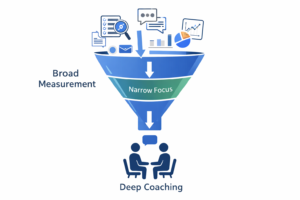
A. Increasing the volume of monitoring data alone improves coaching outcomes
B. Broad or multiple monitoring findings must be narrowed and focused to enable effective coaching
C. Coaching should be replaced by more comprehensive monitoring
D. The primary goal of monitoring is to capture as much data as possible
Question 12
Which of the following best describes a Monitoring Form in a Quality Assurance program?
A. A comprehensive document that captures every possible behavior in detail
B. A concise list of key behaviors used to evaluate interactions
C. The central tool that drives overall Quality Assurance strategy
D. A scoring document used only by QA and not by Team Leaders
Question 13
Which of the following are risks of over-reliance on compliance standards?
I. Robotic interactions
II. Culture of catching mistakes
III. Reduced quality of the customer experience
IV. Reduced depth and quality in coaching conversations
A. I and II only
B. I, II and III only
C. II, III and IV only
D. I, II, III and IV
Question 14
Scenario: A QA team evaluates a high volume of interactions, identifies every opportunity for improvement, and shares detailed scorecards with Advisors. Despite this, performance has not improved.
What is the most likely issue?
A. Not enough monitoring volume
B. Ineffective coaching conversations
C. The scorecards contain too many Performance Standards
D. Insufficient calibration
Question 15
Scenario: A Team Leader conducts a coaching session where they:
- Identify two strengths
- Focus on one key improvement
- Listen to their team member’s perspective
- Agree on specific next steps
This coaching session is an example of:
A. Monitoring
B. Calibration
C. Performance improvement coaching
D. Compliance evaluation
Finished? Now compare your answers with the Answer Key and detailed explanations below.
Answer Key: Why Each Answer Matters
In the answer key below I’ve bolded the correct answer and provided a detailed explanation of why it is the best answer as compared to the other options.
Question 1
Which of the following best describes the purpose of a Service Delivery Vision?
A. To provide a complete list of performance standards
B. To create a shared definition of what good service looks like
C. To document the purpose of individual performance standards
D. To communicate the value of the Contact Center to the organization
Quality Principle
A Service Delivery Vision defines the experience an organisation wants Customers to receive. It gives leaders, evaluators, and Advisors a shared understanding of what good service looks like.
Why is B the best answer?
A Service Delivery Vision creates a shared definition of good service across the organisation.
Without this shared understanding, people may evaluate service according to their personal preferences. One evaluator may focus on efficiency, another on friendliness, and another on strict process compliance.
This creates inconsistency in evaluation, coaching, and the Customer experience.
The Service Delivery Vision provides the foundation for the Quality Assurance program. It describes the intended Customer experience in clear, practical terms and helps everyone understand the type of service the organisation wants to deliver.
Performance Standards are then developed from that vision, translating the desired Customer experience into observable, measurable behaviours.
Why not A?
A Service Delivery Vision is not a complete list of Performance Standards.
It provides the broader definition of the service experience the organisation wants to deliver. The Performance Standards are developed separately and describe the specific behaviours, actions, and requirements used to evaluate how effectively the vision is being delivered.
Why not C?
Documenting the purpose of individual Performance Standards may be useful, but it is not the purpose of the Service Delivery Vision.
The vision operates at a higher level by defining what good service looks like. The purpose of each individual Performance Standard should be documented as part of the Quality Assurance design process.
Why not D?
Communicating the value of the Contact Center to the wider organisation is important, but it is not the purpose of a Service Delivery Vision.
The Service Delivery Vision focuses on defining the Customer experience the organisation intends to deliver. Demonstrating the value of the Contact Center is a broader organisational responsibility.
Quality Insight
Quality Assurance becomes inconsistent when people who work in the same organisation do not share the same definition of good service.
A clear Service Delivery Vision provides the foundation for Performance Standards, monitoring, calibration, and coaching. It ensures everyone is working towards the same definition of service excellence.
Question 2
Which of the following should be considered when selecting Performance Standards?
I. Customer expectations
II. Mission, Vision, and Values
III. Regulatory requirements
IV. Personal preferences of individual evaluators
A. I and II only
B. I, II and III only
C. II, III and IV only
D. I, II, III and IV
Quality Principle
Effective Performance Standards should reflect what matters most to Customers, the organisation, and any legal or regulatory obligations. Together, these factors help ensure that the Quality Assurance program supports both the Customer experience and the organisation’s objectives.
Why is B the best answer?
Customer expectations, the organisation’s Mission, Vision, and Values, and regulatory requirements are all important considerations when developing Performance Standards.
Customer expectations help define the experience the organisation wants to deliver. The Mission, Vision, and Values ensure the standards reflect the organisation’s culture and strategic direction. Regulatory requirements ensure Advisors consistently meet legal, industry, and compliance obligations.
By considering all three, organisations create Performance Standards that are balanced, relevant, and aligned with both business objectives and Customer needs.
Why not A?
This answer is incomplete.
While Customer expectations and the organisation’s Mission, Vision, and Values are important, regulatory requirements must also be considered. Ignoring legal or compliance obligations can expose the organisation to significant operational and regulatory risk.
Why not C?
This answer excludes Customer expectations.
Quality Assurance should not focus only on organisational priorities and compliance. If the standards do not reflect what Customers value, the organisation may achieve internal targets while still delivering a poor Customer experience.
Why not D?
Personal preferences of individual evaluators should never influence the selection of Performance Standards.
Performance Standards should be based on agreed organisational requirements rather than individual opinions. Allowing evaluators to apply their own preferences leads to inconsistent scoring, unfair evaluations, and reduced confidence in the Quality Assurance process.
Quality Insight
Well-designed Performance Standards balance the needs of Customers, the organisation, and regulatory requirements.
When standards are based on objective business principles rather than personal opinion, they create greater consistency in monitoring, calibration, and coaching, while helping Advisors understand exactly what good performance looks like.
Question 3
Which of the following are potential consequences of having too many Performance Standards to evaluate?
I. Scoring fatigue
II. Calibration difficulty
III. Reduced clarity for Advisors
IV. Reduced focus during coaching
A. I and II only
B. I, II and IV only
C. II and III only
D. I, II, III and IV
Quality Principle
Quality Assurance should focus on the behaviours that have the greatest impact on the Customer experience and business performance. Too many Performance Standards can make evaluations more complicated, reduce consistency, and make coaching less effective.
Why is D the best answer?
Having too many Performance Standards can create several challenges for a Quality Assurance program.
As the number of standards increases, evaluations become longer and more complex, leading to scoring fatigue for evaluators. More standards also increase the likelihood of inconsistent interpretation, making calibration more difficult.
For Advisors, a lengthy list of Performance Standards can reduce clarity about what is most important. Instead of concentrating on a manageable number of high-impact behaviours, they may feel overwhelmed by too many requirements.
The same challenge affects coaching. When too many behaviours are measured, Team Leaders are more likely to discuss multiple development areas during a coaching session, reducing focus and making it harder for Advisors to retain and apply the feedback.
For these reasons, all four statements are potential consequences of having too many Performance Standards.
Why not A?
This answer is incomplete.
While scoring fatigue and calibration difficulty are genuine risks, having too many Performance Standards can also reduce clarity for Advisors and make coaching less focused and effective.
Why not B?
This answer correctly identifies scoring fatigue, calibration difficulty, and reduced coaching focus, but it overlooks another important consequence.
When Advisors are expected to understand, remember, and apply too many standards, they often lose sight of the behaviours that matter most, reducing clarity and confidence.
Why not C?
This answer identifies two valid consequences but omits two others.
Scoring fatigue affects evaluator performance, while reduced coaching focus makes it more difficult for Advisors to improve. Both are important considerations when designing a Quality Assurance program.
Quality Insight
A good Quality Assurance program is not measured by the number of Performance Standards it contains, but by how effectively those standards support consistent service and meaningful coaching.
The most successful programs identify the critical behaviours that drive the Customer experience, making it easier to evaluate performance fairly, coach effectively, and help Advisors improve over time.
Question 4
Which of the following best describes a judgement-based Performance Standard?
A. Binary and rule-based
B. Focused on adherence to predefined rules and requirements
C. Requires the evaluator to assess the Advisor’s performance using agreed standards and rating scales
D. Only used for regulatory environments
Quality Principle
Not every aspect of Customer service can be measured with a simple yes-or-no answer. Some aspects of service require evaluators to apply professional judgement using clearly defined criteria to assess the quality of an interaction.
Why is C the best answer?
A judgement-based Performance Standard requires the evaluator to assess an Advisor’s performance using agreed standards and rating scales.
Unlike binary standards, which simply determine whether a required action did or did not occur, judgement-based standards assess how well an Advisor demonstrated a particular behaviour. Examples include showing empathy, building rapport, actively listening, or explaining information clearly.
We typically recommend using a three-point scale such as 3–2–1 or Excellent, Good, Fair to provide sufficient granularity without losing the big picture.
Although these standards and scales involve professional judgement, they should never be based on personal opinion. The organisation should define what good performance looks like through clear Performance Standards, examples, and regular calibration so that evaluators apply the standards consistently and fairly.
Why not A?
Binary and rule-based standards describe compliance or objective Performance Standards.
These standards measure whether a required action was completed, such as confirming a Customer’s identity or reading a mandatory disclosure. They require little interpretation because the evidence is generally clear.
Why not B?
Performance Standards that focus on adherence to predefined rules and requirements are typically compliance standards. They are designed to ensure Advisors consistently meet organisational policies, regulatory requirements, and legal obligations
Why not D?
Judgement-based Performance Standards are used in many Customer Service environments, not only those with regulatory requirements.
They are particularly valuable when evaluating behaviours that influence the Customer experience, such as communication skills, empathy, ownership, professionalism, and problem-solving.
Quality Insight
The strongest Quality Assurance programs use both compliance and judgement-based Performance Standards.
Compliance standards help ensure Advisors meet required standards, policies, and procedures, while judgement-based standards evaluate how effectively they deliver the Customer experience and organisational brand.
Question 5
Which of the following statements about monitoring is TRUE?
A. Monitoring provides data that supports development
B. Monitoring directly improves Advisor performance
C. Monitoring replaces coaching
D. Monitoring eliminates evaluator subjectivity
Question 6
Which of the following are strategic objectives of monitoring?
I. Evaluate performance and support coaching and development
II. Capture Voice of the Customer
III. Identify process improvements
IV. Replace Customer Satisfaction surveys
A. I and II only
B. I, II and III only
C. II, III and IV only
D. I, II, III and IV
Quality Principle
Quality Assurance monitoring serves many strategic purposes across an organisation.
Some objectives support Contact Center Management — including evaluating performance, supporting coaching and development, identifying process improvements, and understanding the Customer experience.
Others may support functions such as Compliance, Risk Management, Legal, Human Resources, or Information Security by providing evidence, identifying risks, or verifying compliance.
Why is B the best answer?
Monitoring can support several important strategic objectives.
In the Contact Center, it evaluates Advisor performance against the organisation’s Service Delivery Vision and Performance Standards and provides the information needed for effective coaching and development.
For a CX Team, monitoring can reveal the Voice of the Customer — what Customers experience during real interactions. Evaluators can identify recurring Customer concerns, compliments, frustrations, and unmet needs, providing valuable insight into the Customer experience.
For a process improvement team, monitoring helps identify opportunities to improve processes. Evaluators often identify inefficient procedures, system limitations, confusing policies, and recurring Customer issues that can be addressed.
Although monitoring provides valuable Customer insight, it does not replace Customer Satisfaction surveys. Surveys capture the Customer’s own perception of the experience, while monitoring evaluates the interaction from the organisation’s perspective. Both are valuable, but they answer different questions.
Why not A?
This answer is incomplete. While evaluating performance and capturing the Voice of the Customer are both important objectives, monitoring also helps organisations identify process improvement opportunities that extend beyond individual Advisor performance.
Why not C?
This answer incorrectly includes replacing Customer Satisfaction surveys. Monitoring and Customer surveys complement one another. Monitoring evaluates the interaction, while surveys capture the Customer’s own assessment of their experience.
Why not D?
This answer includes all four statements, including replacing Customer Satisfaction surveys. Although monitoring provides valuable insights into Customer interactions, it should never be viewed as a substitute for listening directly to Customers through surveys or other feedback channels.
Quality Insight
Monitoring creates value far beyond evaluating Advisors by providing insights that can improve processes, products, policies, and the Customer experience.
Question 7
Calibration primarily ensures:
A. Faster evaluation cycles
B. Consistency and fairness in evaluation
C. Higher QA scores for Advisors
D. Reduced need for monitoring
Quality Principle
Calibration helps ensure that Performance Standards and scoring guidelines are applied consistently and fairly. By discussing evaluations, resolving differences, and agreeing on how standards should be interpreted, organisations improve the reliability and credibility of their Quality Assurance program.
Why is B the best answer?
The primary purpose of calibration is to improve consistency and fairness in evaluation.
Even when evaluators use the same Performance Standards, they may interpret Advisor behaviours differently. During calibration sessions, evaluators review the same interactions, compare their scores, discuss differences in interpretation, and reach agreement on how the standards should be applied.
This process helps ensure that Advisors receive fair and consistent evaluations regardless of who performs the evaluation.
Why not A?
Calibration is not primarily intended to make evaluations faster. Its purpose is to improve the consistency and quality of evaluations.
Why not C?
Calibration is not designed to increase Quality Assurance scores. It is designed to improve scoring accuracy and consistency.
Why not D?
Calibration does not reduce the need for monitoring. Instead, it helps ensure that monitoring is carried out consistently and fairly.
Quality Insight
Without calibration, the same Customer interaction could receive different scores from different evaluators. Regular calibration helps ensure that Performance Standards are applied consistently, making Quality Assurance more reliable, credible, and fair.
Question 8
Which of the following best describes the role of a scorecard?
A. A coaching tool that directly changes behaviour
B. A replacement for Team Leader involvement
C. A measurement tool that identifies where to focus
D. A tool used only for compliance
Question 9
Which of the following is the best approach to coaching an Advisor?
A. Cover all observed behaviours in one session
B. Focus on one or two high-impact behaviors for improvement
C. Focus only on weaknesses
D. Avoid giving specific examples
Quality Principle
Effective coaching focuses on helping people improve, not trying to correct every issue at once. Concentrating on one or two high-impact behaviours makes it easier for Advisors to understand the feedback, apply it consistently, and achieve meaningful improvement.
Why is B the best answer?
Focusing on one or two high-impact behaviours allows the Team Leader and Advisor to concentrate on the behaviours that will have the greatest positive impact on performance.
This approach improves learning, increases the likelihood that new behaviours will be applied consistently, and creates a clear focus for follow-up coaching.
Once these behaviours have improved, additional or new development areas can be addressed in future coaching sessions.
Why not A?
Covering every observed behaviour in a single coaching session can overwhelm the Advisor and reduce the effectiveness of the coaching. Trying to improve everything at once often results in little meaningful improvement.
Why not C?
Effective coaching should recognise strengths as well as opportunities for improvement. Acknowledging what an Advisor is doing well helps build confidence and encourages those positive behaviours to continue.
Why not D?
Specific examples help Advisors understand exactly what they did well and what they can improve. Vague or general feedback is much less effective because it provides little guidance on how to improve future performance.
Quality Insight
One of the most common coaching mistakes is trying to fix everything at once. Effective Team Leaders prioritise the behaviours that will have the greatest impact, helping Advisors achieve meaningful improvement one step at a time.
Question 10
Which of the following statements best describes the relationship between scoring an interaction and helping an Advisor?
A. Scoring an interaction is more important than helping an Advisor
B. Helping an Advisor can replace scoring an interaction
C. Both scoring and helping an Advisor are required and serve distinct purposes
D. Neither helping nor scoring an Advisor is necessary with strong systems
Quality Principle
Scoring and coaching are complementary activities that serve different purposes. Scoring evaluates performance against defined standards, while helping an Advisor improves future performance. Effective Quality Assurance requires both.
Why is C the best answer?
Scoring an interaction provides an objective assessment of how well an Advisor performed against the organisation’s Performance Standards.
Helping an Advisor uses those findings to identify strengths, address improvement opportunities, and support ongoing development.
One measures performance, while the other develops future performance. Together, they form the foundation of an effective Quality Assurance process.
Why not A?
Scoring an interaction is important, but it does not improve performance on its own. Without effective coaching and development, evaluations have limited value.
Why not B?
Helping an Advisor cannot replace scoring because coaching needs to be based on objective observations and consistent evaluations. Scoring provides the evidence that supports meaningful coaching conversations.
Both activities are essential. Scoring identifies current performance, while helping improves future performance. The more effectively we help Advisors improve, the better future Quality Assurance scores are likely to be.
Why not D?
Even with excellent systems and processes, organisations still need to evaluate performance and help Advisors continue developing their skills. Quality Assurance and coaching remain essential to maintaining high standards and continuous improvement.
Quality Insight
Some organisations invest heavily in monitoring and scorecards but devote far less attention to coaching.
The greatest value of Quality Assurance is realised when accurate evaluations are combined with effective coaching conversations that help Advisors improve their performance over time.
Question 11
Based on the diagram shown, which of the following best reflects the relationship between monitoring data and coaching?
A. Increasing the volume of monitoring data alone improves coaching outcomes
B. Broad or multiple monitoring findings must be narrowed and focused to enable effective coaching
C. Coaching should be replaced by more comprehensive monitoring
D. The primary goal of monitoring is to capture as much data as possible
Quality Principle
Monitoring provides a broad understanding of performance by identifying strengths and opportunities for improvement.
Effective coaching narrows that information into a small number of high-impact development priorities that an Advisor can realistically address.
Why is B the best answer?
Monitoring often identifies multiple strengths and opportunities for improvement across an interaction. Effective coaching does not attempt to address everything at once.
Instead, the Team Leader narrows the discussion to one or two high-impact behaviours that are most likely to improve future performance. This focused approach improves learning, retention, and the likelihood of lasting behavioural change.
Why not A?
Increasing the volume of monitoring data may provide more information, but information alone does not improve performance. The quality of the coaching conversation is what turns monitoring findings into meaningful improvement.
Why not C?
Monitoring and coaching serve different purposes and cannot replace one another. Monitoring evaluates performance, while coaching helps Advisors improve future performance.
Why not D?
The purpose of monitoring is not simply to collect as much data as possible. It is to gather meaningful information that supports performance evaluation, coaching, organisational improvement, and better Customer outcomes.
Quality Insight
One of the most important skills of an effective Team Leader is knowing what not to coach.
Prioritising one or two high-impact behaviours creates focused coaching conversations that are easier for Advisors to understand, remember, and apply, leading to more meaningful and sustainable performance improvement.
Question 12
Which of the following best describes a Monitoring Form in a Quality Assurance program?
A. A comprehensive document that captures every possible behavior in detail
B. A concise list of key behaviors used to evaluate interactions
C. The central tool that drives overall Quality Assurance strategy
D. A scoring document used only by QA and not by Team Leaders
Quality Principle
A Monitoring Form is a practical tool used to evaluate interactions against a concise set of defined Performance Standards. It should focus on the behaviours that matter most rather than attempting to measure every possible aspect of an interaction.
Why is B the best answer?
A well-designed Monitoring Form contains a concise list of key behaviours that reflect the organisation’s Service Delivery Vision, organisational branding and requirements, and Customer expectations.
By focusing on the most important aspects of performance, it enables consistent evaluations that support the organisation’s intentional quality standards.
Why not A?
A Monitoring Form should not attempt to capture every possible behaviour in detail. Overly complex forms make evaluations more difficult, reduce consistency, and make coaching less focused and effective.
Why not C?
A Monitoring Form is an important component of a Quality Assurance program, but it does not drive the overall strategy.
The Quality Assurance strategy is guided by the organisation’s Service Delivery Vision, Performance Standards, coaching approach, calibration process, and continuous improvement activities.
Why not D?
Monitoring Forms are valuable tools for both Quality Assurance Specialists and Team Leaders. Using the same evaluation criteria helps create consistency between monitoring, coaching, and performance development.
Quality Insight
One of the most common mistakes in Quality Assurance is believing that a better Monitoring Form will automatically improve performance.
In reality, the Monitoring Form identifies performance against agreed standards. Its true value is realised when the information it provides is used to deliver focused coaching that helps Advisors improve over time.
Question 13
Which of the following are risks of over-reliance on compliance standards?
I. Robotic interactions
II. Culture of catching mistakes
III. Reduced quality of the customer experience
IV. Reduced depth and quality in coaching conversations
A. I and II only
B. I, II and III only
C. II, III and IV only
D. I, II, III and IV
Quality Principle
Compliance standards are essential for managing risk and meeting organisational and regulatory requirements. However, an effective Quality Assurance program should also evaluate judgement, communication skills, and Customer experience.
Over-reliance on compliance standards can reduce the effectiveness of both service delivery and coaching.
Why is D the best answer?
All four statements describe genuine risks of relying too heavily on compliance standards.
- Advisors may become more focused on following rules than responding naturally to Customers
- Quality Assurance can develop into a culture of catching mistakes instead of supporting improvement.
- Customer experience may suffer because important behaviours such as empathy, ownership, and communication receive less attention.
- Coaching conversations may also become narrower and less effective, concentrating on rule compliance rather than helping Advisors build stronger overall performance.
Why not A?
While robotic interactions and a culture of catching mistakes are genuine risks, they are not the only consequences. Over-reliance on compliance standards can also affect the Customer experience and reduce the effectiveness of coaching.
Why not B?
This answer recognises several important risks but overlooks the impact on coaching. When coaching focuses primarily on compliance, it often becomes less developmental and less effective at improving overall performance.
Why not C?
Although these are all valid risks, this answer excludes robotic interactions, which are one of the most common outcomes when Advisors become overly focused on following rules instead of serving Customers naturally.
Quality Insight
The strongest Quality Assurance programs achieve an appropriate balance between compliance and judgement.
Compliance standards help organisations manage risk and maintain consistency, while judgement-based standards encourage Advisors to bring their personality to life, grow their communication skills, and deliver a meaningful Customer experience.
Question 14
Scenario: A Quality Assurance team evaluates a high volume of interactions, identifies every opportunity for improvement, and shares detailed scorecards with Advisors. Despite this, performance has not improved.
What is the most likely issue?
A. Not enough monitoring volume
B. Ineffective coaching conversations
C. The scorecards contain too many Performance Standards
D. Insufficient calibration
Quality Principle
Monitoring identifies opportunities for improvement, but coaching determines whether improvement actually occurs. The effectiveness of coaching should be judged by meaningful improvements in Advisor performance over time.
Why is B the best answer?
The scenario describes a Quality Assurance process that identifies performance opportunities and shares detailed feedback.
If performance still does not improve, the most likely issue is that the coaching conversations are not effectively helping Advisors improve their performance. Effective coaching leads to meaningful and sustained performance improvement over time.
Why not A?
The scenario already states that a high volume of interactions is being monitored. More monitoring is unlikely to solve the problem if the coaching process is ineffective.
Why not C?
The scenario does not indicate that the scorecards contain too many Performance Standards. Even if the scorecards contain many observations, effective coaching should still help Advisors prioritise one or two high-impact improvement opportunities.
Why not D?
Calibration improves the consistency and fairness of evaluations, but there is nothing in the scenario to suggest inconsistent scoring. The issue is that performance is not improving after the evaluations have been completed.
Quality Insight
Not all coaching produces the same results.
- Effective coaching leads to meaningful improvements in performance over time.
- Ineffective coaching produces little or no lasting change.
- Destructive coaching can actually reduce confidence, motivation, and performance.
The goal of every coaching conversation is not simply to discuss performance, but to help Advisors improve it.
Question 15
Scenario: A Team Leader conducts a coaching session where they:
- Identify two strengths
- Focus on one key improvement
- Listen to their team member’s perspective
- Agree on specific next steps
This coaching session is an example of:
A. Monitoring
B. Calibration
C. Performance improvement coaching
D. Compliance evaluation
Quality Principle
Performance improvement coaching involves a structured conversation that helps Advisors build on their strengths, improve key behaviours, and commit to specific actions that enhance future performance.
Why is C the best answer?
This scenario demonstrates the key elements of effective performance improvement coaching.
The Team Leader recognises strengths, focuses on one high-impact improvement area instead of trying to address everything at once, listens to the Advisor’s perspective, and agrees on specific next steps.
Together, these behaviours create a coaching conversation that encourages learning, ownership, and meaningful performance improvement.
Why not A?
Monitoring is the process of observing and evaluating performance against defined Performance Standards. It identifies opportunities for improvement but does not involve the coaching conversation itself.
Why not B?
Calibration ensures that evaluators apply Performance Standards consistently and fairly. It is an important Quality Assurance activity but is not a coaching conversation with an Advisor.
Why not D?
Compliance evaluation focuses on determining whether required standards and procedures have been followed. While compliance may be discussed during coaching, the scenario clearly describes a developmental coaching conversation rather than an evaluation of compliance.
Quality Insight
The purpose of coaching is not simply to review past performance. It is to help Advisors improve future performance.
The most effective coaching conversations are structured to recognise strengths, prioritise one or two meaningful development opportunities, encourage open discussion, and conclude with clear actions that the Team Leader and Advisor can follow up on together.
End of Answer Key & Explanations
Continue Your Quality Assurance Development
If you’d like to go deeper into some of the concepts covered in this quiz, these articles will help.
15 Quiz Questions on Quality Assurance (Part 1)
Where Quality Assurance Programs Break Down
When You Coach You’re Either Helping or You’re Keeping Score
Your Super High Quality Scores May Be Holding Your Team Back
We Have a Quality Program. So Why Isn’t Quality Improving?
Selecting Quality Standards for Better Customer Conversations
True Calls Per Hour: Balancing Quality and Productivity in Your Contact Center
That Won’t Work for Our Customers: A Common Mistake in Service Design
What a Great Quality Assurance Professional Can Do
Thank You for Reading
I regularly share stories, strategies, and insights from our work across Contact Centers, Customer Service, and Customer Experience. If this article resonated with you, I’d be pleased to stay connected.
Feel free to get in touch anytime, or explore more of our work below.
Daniel Ord
[email protected]
www.omnitouchinternational.com

*Banner image by Adrià Crehuet Cano on Unsplash