
)
These 15 quiz questions are designed to test your understanding and judgment in Contact Center Operations Management.
This quiz is part of our Professional Quizzes collection.
It is also a part of our Contact Center Management Series — a collection of articles that bring together practical guidance and insights to help Contact Centers run better and deliver stronger results.
The Purpose of this Quiz
Contact Center Operations sits at the heart of customer experience, employee experience, and organizational performance.
These questions were inspired by the thousands of Contact Center leaders, managers, agents, and support professionals we’ve worked with through our Contact Center Management courses around the world.
Looking for an additional challenge? Continue with our Part 2 Quiz here.
Instructions
- Each scenario has one best answer (A–D).
- Complete all 15 questions before checking the answers.
- You’ll find the Answer Key and detailed explanations at the end of the article.
- Take your time, think carefully, and enjoy the challenge.
Question 1
Which of the following contact types typically require the use of a Service Level objective when calculating staffing requirements?
I. Outbound calls
II. Email with 24-hour response time
III. Live chat
IV. Walk-ins
A. I only
B. I and IV only
C. II and III only
D. III and IV only
Question 2
Which of the following is the industry standard Service Level?
A. 80% answered in 20 seconds
B. 90% answered in 30 seconds
C. Industry standards only exist for vertical industries
D. There is no industry standard
Question 3
A Contact Center has recently established KPI targets. The Service Level objective is 80% answered in 20 seconds and the Average Speed of Answer (ASA) objective is 10 seconds. The Center also plays a required announcement before callers enter the queue.
Given this information, which of the following statements is true?
A. The Center is measuring typical callers’ experience more effectively than Centers that measure Service Level alone
B. Setting both Service Level and ASA targets is not appropriate
C. To be most meaningful ASA should be measured as an end-of-day average
D. The timing of ASA should begin as soon as the required announcement starts
Question 4
Based on the information below, what is the overall Abandonment Rate for the week (Monday-Friday)?
- Total calls answered: 9,479
- Total calls abandoned: 702
Daily Abandonment Rates:
Monday: 10.4%
Tuesday: 7.4%
Wednesday: 5.4%
Thursday: 3.4%
Friday: 7.0%
A. 6.9%
B. 9.2%
C. 11.5%
D. 5.0%
Question 5
When managing the queue in real time, which of the following real-time statistics should you look at first?
A. Agent status
B. Longest current wait
C. Number of calls in queue
D. Average time to abandonment
Question 6
Which of the following statements is/are TRUE?
I. Occupancy is the percentage of time Advisors spend talking to Customers or completing after-call work
II. Occupancy is a result of random call arrival
III. When Service Level increases, Occupancy increases
IV. When Occupancy is very high for extended periods, Advisors tend to work harder to clear the queue
A. II only
B. I and II only
C. II and IV only
D. I, III and IV only
Question 7
If an Advisor arrives 30 minutes late to work on calls or live chats, which of the following actions would benefit the Center the most?
A. Stay 30 minutes extra at the end of the shift
B. Skip morning and afternoon breaks (15 minutes each)
C. Return 30 minutes early from a one-hour lunch break
D. Take breaks and lunch as normal and leave at the scheduled time
Question 8
Which one of the following statements is FALSE?
A. Using the number of calls handled as an Advisor productivity standard is good practice
B. Adherence to Schedule is an important productivity measure for Advisors handling Service Level-based contacts
C. When Adherence to Schedule improves, Service Level improves
D. Most of what drives Average Handling Time lies outside the control of the Advisor
Question 9
Which statement is MOST correct?
A. To achieve productivity objectives, Advisors must sacrifice quality
B. Average Handling Time is the most important productivity standard
C. Advisors are accountable for Service Level performance
D. It is possible to design metrics that enable Advisors to achieve both quality and productivity objectives
Question 10
The best definition of Time Series forecasting is:
A. A method where the past is a good basis for predicting the future
B. A method used only in rare circumstances
C. A method that covers the qualitative side of forecasting
D. A method that does not require judgment
Question 11
What variables does Erlang C require to perform staffing calculations?
I. Average Handling Time
II. Call volume
III. Number of abandoned calls
IV. Service Level objective
A. I and II only
B. I, II and III only
C. I, II and IV only
D. II, III and IV only
Question 12
Your Contact Center expects 200 emails between 9:00 a.m. and 10:00 a.m. The Average Handling Time is 8 minutes. The response time target is 4 hours.
Which staffing scenario meets the objective?
I. 4 Advisors working 10:00 a.m. to 5:00 p.m.
II. 9 Advisors working 10:00 a.m. to 1:00 p.m.
III. 14 Advisors working 10:00 a.m. to 12:00 p.m.
IV. 40 Advisors working one hour each between 10:00 a.m. and 1:00 p.m.
A. II only
B. III and IV only
C. II, III and IV only
D. I, II, III and IV
Which of the following must be incorporated into a monthly labor budget calculation?
I. Is my Advisor at work?
II. What is the monthly average Occupancy rate?
III. Is my Advisor on a break?
IV. Is my Advisor on leave?
A. III only
B. I and II only
C. I, II and III only
D. I, II, III and IV
Question 14
A Delay Profile is especially useful to:
A. Calculate your Longest Wait Time
B. Calculate required staffing levels
C. Estimate cross-training requirements
D. Calculate your Shrinkage rate
Question 15
Which accessibility metric provides the clearest indication of the wait time experienced by a typical caller?
A. Average Speed of Answer
B. Service Level
C. Percent abandoned
D. Percent answered
Finished? Now compare your answers with the Answer Key & Explanations below.
Answer Key: Why Each Answer Matters
In the answer key below, the correct answer is bolded and accompanied by a detailed explanation of why it is the best answer compared with the other options.
Question 1
Which of the following contact types typically require the use of a Service Level objective when calculating staffing requirements?
I. Outbound calls
II. Email with 24-hour response time
III. Live chat
IV. Walk-ins
A. I only
B. I and IV only
C. II and III only
D. III and IV only
Operations Principle
Understanding when to use Service Level versus Response Time as the Customer Wait Time objective is fundamental to effective Contact Center planning and management.
Why is D the best answer?
Service Level is the appropriate wait time objective to use when Customers should be answered immediately or within a reasonable timeframe.
Live chat and phone calls are channels where Customers expect a timely response. Similarly, Customers who walk into a Customer Service Centre or retail location expect to be served without an unreasonable delay.
Why not A?
Outbound calling does not require a Service Level objective because Customers are not waiting for the organisation to answer their request.
Why not B?
While walk-ins are appropriately managed using a Service Level objective, outbound calls are not. Therefore, this combination is not correct.
Why not C?
Email with a 24-hour response target is managed using a Response Time objective rather than Service Level. 24-hours would not qualify as an immediate response.
Operations Insight
Understanding when to use Service Level versus Response Time as the Customer wait time objective is fundamental to effective Contact Center planning and management.
Immediate-response channels, such as voice, live chat, and walk-ins, are planned and managed using Service Level objectives.
Deferred-response channels, such as email, and postal mail are managed using Response Time objectives.
As a practical rule, Service Level is used when the wait time objective is less than 60 minutes, while Response Time is used when the objective is 60 minutes or longer.
Question 2
Which of the following is the industry standard Service Level?
A. 80% answered in 20 seconds
B. 90% answered in 30 seconds
C. Industry standards only exist for vertical industries
D. There is no industry standard
Operations Principle
One of the most common misconceptions in Contact Center Management is that there is a single industry standard Service Level.
In reality, Service Level objectives are determined by a few variables, including the Customer Experience the organisation wants to deliver, not by a number that has been adopted by others.
Why is D the best answer?
Despite what many people believe, there is no universal industry standard for Service Level.
The commonly quoted objective of 80% answered in 20 seconds has been widely used for many years, but it is not an industry standard.
The appropriate Service Level depends on many factors, including Customer expectations, the type of contact being handled, operating costs, and the Customer Experience the organisation wants to provide.
For some organisations, 80/20 may be appropriate. Others may choose 90/10, 60/80, or another objective that better aligns with their operational and Customer Experience goals.
Why not A?
Although 80% answered in 20 seconds is one of the most commonly used Service Level objectives in the industry, it is not a recognised industry standard.
It is simply one of many Service Level targets that organisations may choose to adopt.
Why not B?
Some organisations deliberately choose higher or different Service Level objectives based on their business model or Customer expectations.
While 90% answered in 30 seconds may be appropriate for some environments, it is no more an industry standard than any other Service Level objective.
Why not C?
Some industries may develop common practices or typical Service Level objectives, but these are not formal industry standards.
Even within the same industry, organisations often adopt different Service Level objectives depending on their Customers, operating model, and strategic priorities.
Operations Insight
Choosing Service Level objectives is a management decision, not an industry rule.
Rather than asking, “What is the industry standard?”, experienced Contact Center leaders ask what wait time experience do we want our Customers to have, what level of resources is required to achieve that, and even the value of that conversation.
Once the decision has been made, staffing, scheduling, and operational processes are designed to consistently achieve that objective.
Question 3
A Contact Center has recently established KPI targets. The Service Level objective is 80% answered in 20 seconds and the Average Speed of Answer (ASA) objective is 10 seconds. The Center also plays a required announcement before callers enter the queue.
Given this information, which of the following statements is true?
A. The Center is measuring typical callers’ experience more effectively than Centers that measure Service Level alone
B. Setting both Service Level and ASA targets is not appropriate
C. To be most meaningful ASA should be measured as an end-of-day average
D. The timing of ASA should begin as soon as the required announcement starts
Operations Principle
Effective Contact Center Management requires leaders to distinguish between driver metrics and outcome metrics.
Service Level, when used correctly, is the primary driver of the Customer wait time experience. Average Speed of Answer is an outcome of the Service Level achieved.
Why is B the best answer?
Setting independent targets for both Service Level and ASA is not appropriate because the two measures are directly correlated.
Service Level is the operational driver. It measures the percentage of contacts answered within a defined wait time objective. ASA is an outcome metric. It reflects the average time Customers waited before their contacts were answered.
When Service Level improves, ASA will generally improve by decreasing. When Service Level deteriorates, ASA will generally deteriorate by increasing.
Because ASA moves in response to Service Level performance, it should be viewed as an outcome, not be managed as a separate target.
In addition, there are mathematical realities at work that cause ASA to shift based on the queue size.
Why not A?
Using both Service Level and ASA does not improve the measurement of the Customer experience if the metrics are being managed incorrectly. There is nothing meaningful about having incorrect measurements.
Why not C?
ASA is an outcome of Service Level rather than the primary metric being managed.
In addition, end-of-day averages for any metric provide little operational value because they hide variations in performance throughout the day.
Why not D?
The timing for both Service Level and ASA begins when the Customer has the opportunity to reach a frontline professional. In any case, Service Level remains the preferred metric.
Operations Insight
Setting targets for both a driver and its outcome rarely makes operational sense. Instead, focus on managing the driver. The outcome will generally move in the expected direction.
Question 4
Based on the information below, what is the overall Abandonment Rate for the week (Monday-Friday)?
- Total calls answered: 9,479
- Total calls abandoned: 702
Daily Abandonment Rates:
Monday: 10.4%
Tuesday: 7.4%
Wednesday: 5.4%
Thursday: 3.4%
Friday: 7.0%
A. 6.9%
B. 9.2%
C. 11.5%
D. 5.0%
Operations Principle
Overall percentages should always be calculated using the total underlying volumes rather than averaging daily percentages.
Why is A the best answer?
The weekly Abandonment Rate is calculated using the total number of calls abandoned divided by the total number of calls offered.
Total calls offered = Calls Answered + Calls Abandoned
= 9,479 + 702 = 10,181
Abandonment Rate = 702 ÷ 10,181 = 6.9%
The daily abandonment percentages should not be averaged because each day may have handled a different number of calls.
Why not the other answers?
The other options result from incorrect calculations or assumptions. Only A is correct.
Operations Insight
Know how Abandonment Rate is calculated in your Contact Center.
Different organizations may use different calculation methodologies, so it is important to understand the approach used in your own operation and the logic behind it.
Question 5
When managing the queue in real time, which of the following real-time statistics should you look at first?
A. Advisor status
B. Longest current wait
C. Number of calls in queue
D. Average time to abandonment
Operations Principle
There is a logical process for interpreting a Contact Center dashboard when managing Service Level in real time.
That process incorporates both historical and real-time information to understand current performance and determine whether action is required.
Why is C the best answer?
The number of calls in queue is the first statistic to review because it provides an immediate indication of the current workload awaiting service.
From there, managers interpret the remaining real-time and historical statistics to decide whether the queue is operating according to plan or whether intervention is required.
Why not the other answers?
They don’t begin by looking at the number of calls in queue.
Operations Insight
Learn how to read a Contact Center dashboard properly — and ensure that those responsible for monitoring it know how to interpret the information and make appropriate operational decisions.
Question 6
Which of the following statements is/are TRUE?
I. Occupancy is the percentage of time Advisors spend talking to Customers or completing after-call work
II. Occupancy is a result of random call arrival
III. When Service Level increases, Occupancy increases
IV. When Occupancy is very high for extended periods, Advisors tend to work harder to clear the queue
A. II only
B. I and II only
C. II and IV only
D. I, III and IV only
Operations Principle
Occupancy is one of the most important and misunderstood metrics in Contact Center Management.
Understanding what Occupancy measures — and how it relates to Service Level and Advisors performance — is fundamental to effective operational decision-making.
Why is B the best answer?
Statement I is true because Occupancy measures the percentage of logged-in time that Advisors spend handling Customer contacts or completing after-call work.
Statement II is also true. Occupancy is a natural consequence of the dynamic of random call arrival.
Why not A?
Statement I is also true. Therefore, II only cannot be correct.
Why not C?
Statement IV is not true.
While Advisors may initially try to work faster to clear a growing queue, prolonged periods of high Occupancy often have the opposite effect. As fatigue increases and recovery time disappears, handling times frequently increase rather than decrease.
Why not D?
Statement III is not true. Service Level and Occupancy move in opposite directions. This is one of the fundamental operational relationships in an inbound Contact Center.
Operations Insight
Understanding the relationship between Service Level and Occupancy is fundamental to effective Contact Center Management.
Question 7
If an Advisor arrives 30 minutes late to work on calls or live chats, which of the following actions would benefit the Center the most?
A. Stay 30 minutes extra at the end of the shift
B. Skip morning and afternoon breaks (15 minutes each)
C. Return 30 minutes early from a one-hour lunch break
D. Take breaks and lunch as normal and leave at the scheduled time
Operations Principle
In Contact Center Operations, we need the right number of people in the right place at the right time. An Advisor cannot ‘make up their time’ later on in another interval.
Why is D the best answer?
An Advisor who arrives late reduces the Advisor Capacity required for the interval they were scheduled for.
Which means that Service Level for that interval goes down (unless they are replaced in real-time). The damage they created in Service Level performance is done and it cannot be ‘made up’.
Why are all the other answers wrong?
The damage to Service Level has already been done during the morning interval when the Advisor was scheduled to be available.
Working later, shortening lunch, or skipping breaks does not recover the Service Level that was lost because staffing is needed at the time the workload occurs, not later in the day.
Operations Insight
The metric of Adherence to Schedule is one of the most important in the Center and supports having the right number of people in the right place at the right time.
Question 8
Which one of the following statements is FALSE?
A. Using the number of calls handled as an Advisor productivity standard is good practice
B. Adherence to Schedule is an important productivity measure for Advisors handling Service Level-based contacts
C. When Adherence to Schedule improves, Service Level improves
D. Most of what drives Average Handling Time lies outside the control of the Advisor
Operations Principle
Each answer option to this question is an individual lesson in Contact Center operations. It is important to understand each lesson.
Why is A false?
The dynamics of random arrival including the inverse relationship between Service Level and Occupancy, the selection of the Service Level objective, the Pooling Principle, forecasting, staffing, scheduling, and real-time management practices all lie outside the control of the Advisor.
Measuring or targeting Advisors on the quantity of calls, chats, or walk-in Customers they handle is completely incorrect and remains one of the most damaging practices in the Contact Center industry.
Why are the other answers all true?
Adherence to Schedule is an important productivity measure because it ensures Advisors are available in the right place at the right time.
As Advisor Adherence improves, Service Level generally improves — assuming correct forecasting and planning.
Average Handling Time is also driven by many factors outside the Advisor’s control, including Customer needs, call mix, Customer mix, business processes, systems, knowledge resources, and call complexity.
While Advisors contribute to AHT through the application of quality, most of what drives it lies elsewhere.
Operations Insight
Before you can deliver great outcomes for Customers, Employees, and the Organization, it’s critical to have a strong understanding of operational principles and practices.
Question 9
Which statement is MOST correct?
A. To achieve productivity objectives, Advisors must sacrifice quality
B. Average Handling Time is the most important productivity standard
C. Advisors are accountable for Service Level performance
D. It is possible to design metrics that enable Advisors to achieve both quality and productivity objectives
Operations Principle
Effective Contact Center Management is about designing objectives and performance measures that enable Advisors to achieve both quality and productivity outcomes.
Why is D the best answer?
Well-designed Contact Centers create performance measures that encourage the correct operational and quality behaviors rather than forcing Advisors to choose between quality and productivity.
When service standards, quality standards, workforce management practices, coaching, systems, and business processes are properly designed, Advisors can consistently deliver high-quality Customer interactions while also achieving well-selected productivity objectives.
Why are all the other answers wrong?
Agents should never be expected to sacrifice quality to achieve productivity objectives. In fact, quality often improves productivity by reducing repeat contacts, unnecessary transfers, and Customer dissatisfaction.
Average Handling Time is an important operational measure, but it is not the most important productivity standard for Advisors. Measures such as Adherence to Schedule often have a greater impact on Contact Center performance.
Finally, Advisors are not accountable for achieving Service Level. Service Level is a management responsibility influenced by forecasting, staffing, scheduling, real-time management, and many other operational factors that lie outside the Advisor’s control.
Operations Insight
One of the objectives of effective Contact Center Management is to design measures and management practices that enable Advisors to succeed in their role rather than forcing them to choose one objective at the expense of another.
Question 10
The best definition of Time Series forecasting is:
A. A method where the past is a good basis for predicting the future
B. A method used only in rare circumstances
C. A method that covers the qualitative side of forecasting
D. A method that does not require judgment
Operations Principle
Contact Centers use a variety of forecasting methods. Understanding when and how to apply each method is fundamental to effective workforce planning.
Why is A the best answer?
Time Series forecasting assumes that historical patterns provide a useful basis for predicting future demand.
By analyzing past contact volumes and identifying recurring patterns such as trends, seasonality, and day-of-week effects, workforce planners can produce forecasts that help determine future staffing requirements.
Why are all the other answers wrong?
Time Series forecasting is one of the most widely used quantitative forecasting methods in Contact Centers. It is not a method used only in rare circumstances.
Although it uses historical data to predict future demand, experienced workforce planners still apply judgment to account for factors such as marketing campaigns, holidays, system changes, business initiatives, or other events that historical data alone cannot predict.
Operations Insight
Time Series forecasting provides the statistical foundation for most Contact Center forecasts. However, the most accurate forecasts combine quantitative forecasting with informed operational judgment.
Question 11
What variables does Erlang C require to perform staffing calculations?
I. Average Handling Time
II. Call volume
III. Number of abandoned calls
IV. Service Level objective
A. I and II only
B. I, II and III only
C. I, II and IV only
D. II, III and IV only
Operations Principle
Erlang C is one of the most widely used mathematical models for calculating staffing requirements in Contact Centers. To produce staffing calculations, it requires a small number of key operational inputs.
Why is C the best answer?
Erlang C requires three key inputs:
- Contact volume
- Average Handling Time (AHT)
- Service Level objective
Using these inputs, Erlang C estimates the number of staff required to achieve the desired Service Level.
Why are all the other answers wrong?
Although abandonment occurs in real Contact Centers, Erlang C assumes that Customers wait indefinitely for service and therefore does not use the number of abandoned calls as an input.
Any answer that includes abandoned calls is therefore incorrect.
Operations Insight
Understanding the assumptions behind Erlang C is just as important as understanding how to use it.
Every forecasting and staffing model has assumptions and limitations that Contact Center leaders should understand before relying on its results.
Question 12
Your Contact Center expects 200 emails between 9:00 a.m. and 10:00 a.m. The Average Handling Time is 8 minutes. The response time target is 4 hours.
Which staffing scenario meets the objective?
I. 4 Advisors working 10:00 a.m. to 5:00 p.m.
II. 9 Advisors working 10:00 a.m. to 1:00 p.m.
III. 14 Advisors working 10:00 a.m. to 12:00 p.m.
IV. 40 Advisors working one hour each between 10:00 a.m. and 1:00 p.m.
A. II only
B. III and IV only
C. II, III and IV only
D. I, II, III and IV
Operations Principle
Deferred-response channels that use Response Time — such as email and back-office work — are staffed differently from Service Level-based channels.
The objective is to have sufficient staff to complete the expected workload within the required Response Time.
Why is C the best answer?
The VRA Formula calculates the minimum number of staff required by considering:
- the expected Volume,
- the required Response Time, and
- the Average Handling Time (AHT).
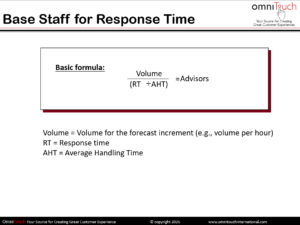
These inputs determine the minimum staffing required to complete the forecast workload within the desired Response Time objective.
Using the VRA Formula for this scenario, we need at least 7 Advisors working full time on the contacts to get them completed on time. Given that criterion, only options II-V will work.
Why are all the other answers wrong?
This is a designed question used to test the use of the VRA Formula.
The incorrect answers either do not provide sufficient staffing to meet the minimum requirement or incorrectly exclude staffing scenarios that exceed the minimum requirement.
In this example, 4 Advisors are fewer than the minimum 7 Advisors required to complete the work within the Response Time objective.
Operations Insight
Unlike Service Level calculations, Response Time staffing does not rely on queueing theory such as Erlang C.
Instead, it calculates the minimum staffing — using linear mathematics rather than queueing mathematics such as Erlang C.
Once the minimum staffing requirement has been achieved, adding additional staff simply improves Response Time rather than creating an overstaffing problem.
Question 13
Which of the following must be incorporated into a monthly labor budget calculation?
I. Is my Advisor at work?
II. What is the monthly average Occupancy rate?
III. Is my Advisor on a break?
IV. Is my Advisor on leave?
A. III only
B. I and II only
C. I, II and III only
D. I, II, III and IV
Operations Principle
Accurate Contact Center budgeting is directly linked to operational knowledge. It is difficult to develop an effective budget without first understanding how the Contact Center operates.
Why is D the best answer?
A comprehensive Contact Center budget considers all of these operational factors, along with many others that influence workload, staffing, technology, facilities, and operating costs.
Operations Insight
Strong Contact Center budgets are built on a solid understanding of forecasting, workforce planning, operational processes, technology, and business requirements.
The better a leader understands Contact Center operations and how they drive operational expenditures, the more accurate and effective the budget is likely to be.
Question 14
A Delay Profile is especially useful to:
A. Calculate your Longest Wait Time
B. Calculate required staffing levels
C. Estimate cross-training requirements
D. Calculate your Shrinkage rate
Operations Principle
A Delay Profile helps Contact Center leaders understand how long Customers actually wait before their contacts are answered. It provides valuable insight into the Customer wait time experience across Customers — not as an average.
Why is A the best answer?
A Delay Profile shows the percentage of contacts answered within different time intervals, allowing managers to identify the Longest Wait Time experienced by Customers and understand how Customer wait times are distributed.
The Longest Wait Time figure is needed as part of the process to read the readerboard or dashboard when managing Service Level in real-time.
Why are all the other answers wrong?
A Delay Profile is a reporting and analysis model. It is not used to calculate staffing requirements, determine cross-training needs, or calculate Shrinkage.
Operations Insight
While Service Level and Average Speed of Answer summarize overall performance, a Delay Profile reveals the full distribution of Customer wait times, making it a useful tool for understanding the actual Customer wait time experience.
Question 15
Which accessibility metric provides the clearest indication of the wait time experienced by a typical caller?
A. Average Speed of Answer
B. Service Level
C. Percent abandoned
D. Percent answered
Operations Principle
Contact Center accessibility metrics measure different aspects of Customer waiting. Understanding what each metric tells you helps managers make better operational decisions.
Why is B the best answer?
Service Level provides the clearest indication of the wait time experienced by a typical caller because it measures the percentage of Customers whose calls are answered within a defined wait time objective (for example, 80% answered within 10 seconds).
Unlike Average Speed of Answer (ASA), which is an average, Service Level reflects the wait time experience of most Customers and is therefore a better indicator of the typical Customer experience.
Why are all the other answers wrong?
The other measures may provide useful operational information but do not describe the typical Customer wait time experience as effectively as Service Level.
Operations Insight
One of the most important principles in Contact Center operations is to manage the drivers rather than the outcomes.
Service Level is the primary accessibility metric because improvements in Service Level naturally lead to better Average Speed of Answer, lower Longest Wait Times, and generally lower Abandonment Rates.
Explore More Contact Center Operations Articles
If you’d like to go deeper into some of the concepts covered in this quiz, these articles will help.
15 Quiz Questions on Contact Center Operations Management (Part 2)
True Calls Per Hour: Balancing Quality and Productivity
Implementing Appropriate Contact Centre Wait Time Metrics
What To Know About the Pooling Principle in Contact Centers
The Pooling Principle in Contact Centers: What Every Manager Should Know
What To Know About Contact Centre Agent Performance
Help Your Contact Centre Team Leaders Do Better — Part 1
Thank You for Reading
I regularly share stories, strategies, and insights from our work across Contact Centers, Customer Service, and Customer Experience. If this article resonated with you, I’d be pleased to stay connected.
Feel free to get in touch anytime, or explore more of our work below.
Daniel Ord
[email protected]
www.omnitouchinternational.com